Elizabeth's attraction to John becomes entangled with a series of increasingly controlling private encounters.
Why this matches +
Selected for the central appeal: Erotic dramas about desire, unequal power and negotiated boundaries.
Genres: Drama / Romance
Shared film traits
Based on recorded story, mood and style. Your preferences can change the order.
What changes 9½ Weeks follows an intense erotic relationship in which experimentation and control become increasingly fraught.
Elizabeth, a recently divorced art gallery assistant, begins an intense relationship with John, a wealthy Wall Street broker she meets in New York. Their private encounters grow increasingly structured around his fantasies and her willingness to surrender control, placing her own boundaries and sense of agency under pressure. As the affair deepens, Elizabeth has to decide whether desire and attention justify the emotional cost of their arrangement.
Lee’s growing confidence changes the terms of her relationship, and her capacity to state desire becomes central to the film’s account of intimacy.
Why this matches +
Selected for the central appeal: Erotic dramas about desire, unequal power and negotiated boundaries.
Genres: Drama / Romance
Shared film traits
Based on recorded story, mood and style. Your preferences can change the order.
What changes Secretary explores a dominant-submissive relationship and the protagonists' negotiations around desire and power.
After leaving psychiatric care, Lee Holloway takes a secretarial job and develops a consensual but unconventional relationship with her demanding employer. Their connection brings questions of agency, boundaries and self-acceptance into both the office and Lee’s home life. The film approaches desire through awkwardness and negotiation rather than treating difference as a simple problem to cure. Restrained framing and intimate performances keep the workplace romance focused on power, communication and choice.
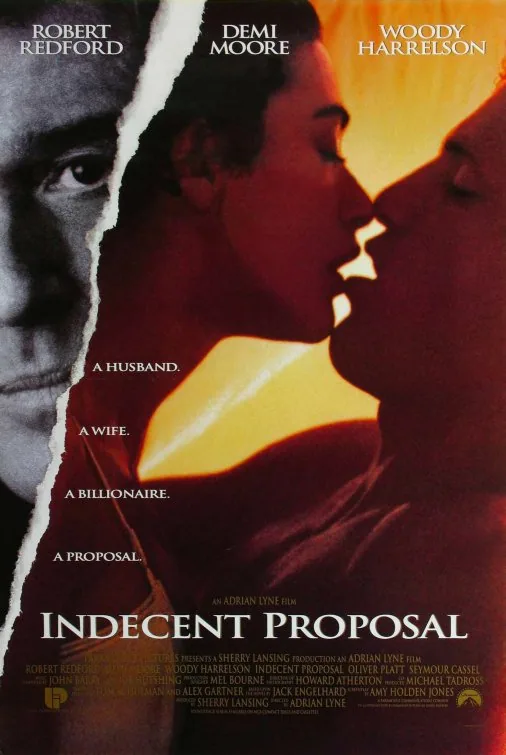
A financial offer meant to isolate sex from marriage produces jealousy and continuing pursuit, exposing how little control the couple has over the bargain’s emotional aftermath. The million-dollar offer follows financial crisis, so consent occurs within pressure rather than a neutral choice.
Why this matches +
These offer a related experience with a meaningful difference in story, tone, or presentation.
An adjacent discovery: a related idea with a different viewing experience.
Genres: Drama / Romance
Shared film traits
Based on recorded story, mood and style. Your preferences can change the order.
What changes Indecent Proposal makes wealth and an intimate proposition the source of tension in a romantic relationship.
When recession threatens the home and business they have built, David and Diana Murphy accept the possibility of a wealthy stranger’s million-dollar offer for one night with Diana. The bargain is described as mutual, but financial desperation, Gage’s wealth and David’s later need to control how Diana recounts the encounter complicate that account of choice. The couple’s shared dream becomes a site of jealousy and possession rather than a neutral transaction with a clear end. The melodrama asks whether love can survive a price placed on intimacy, yet Diana’s agency must stay visible inside a plot that repeatedly lets men frame its meaning.
The coercive premise shapes every romantic beat and should remain visible in reading the relationship.
Why this matches +
These offer a related experience with a meaningful difference in story, tone, or presentation.
An adjacent discovery: a related idea with a different viewing experience.
Genres: Romance / Drama
Shared film traits
Based on recorded story, mood and style. Your preferences can change the order.
What changes 365 Days similarly combines wealthy fantasy romance with troubling coercive dynamics.
Laura’s vacation in Italy takes a disturbing turn when Massimo, the head of a Sicilian crime family, kidnaps her and gives her a year to fall in love with him. Their relationship is framed through luxury, erotic spectacle and criminal power, with the premise drawing a sharp line between fantasy romance conventions and coercion. Barbara Białowąs and Tomasz Mandes make an adult melodrama whose central conflict is inseparable from captivity and unequal control.
A negotiated arrangement around Melinda’s affairs becomes unstable as suspicion grows over the fate of men close to the couple.
Why this matches +
These offer a related experience with a meaningful difference in story, tone, or presentation.
An adjacent discovery: a related idea with a different viewing experience.
Genres: Thriller / Drama
Shared film traits
Based on recorded story, mood and style. Your preferences can change the order.
What changes Deep Water uses erotic jealousy and an affluent couple's power games for a darker domestic thriller.
Vic and Melinda Van Allen remain married while agreeing that Melinda may have affairs, but the arrangement becomes increasingly dangerous when men in her circle begin to disappear. Vic’s detached manner and private explanations fuel suspicion among friends and investigators, while the couple continue to test each other’s boundaries. Adrian Lyne adapts Patricia Highsmith’s novel as an erotic psychological thriller about jealousy, control, and the games played inside a marriage; it includes adult sexual material and threats of violence.
Anastasia’s interview with Christian Grey develops into a relationship where attraction, wealth and inexperience meet his proposed rules for intimacy. Their conversations distinguish boundaries on paper from what each person wants when the arrangement becomes embodied, while his money and access give him greater power to set the terms. Ana’s curiosity does not make every later choice free of pressure, and her refusal remains an active decision rather than a failure to understand his preferences. The film’s erotic framing may make control visually alluring, so its fiction should not be treated as a reliable guide to consent or to real BDSM practice.
What drives the story
A proposed intimate contract appears to make expectations explicit, but the relationship changes as the partners discover that formal terms cannot settle incompatible emotional needs. The contract organizes discussion, but it cannot guarantee that desire and emotional safety align.
The people at its centre
Ana seeks reciprocity while Christian manages vulnerability through control; gifts and economic disparity complicate negotiations without erasing Ana’s ability to refuse. Christian’s wealth changes the practical cost of refusing even when Ana speaks for herself.
What it feels like
Glossy wealth imagery and erotic set pieces place the spectacle of control beside repeated conversations about limits, producing an uneasy courtship rather than a simple fantasy of liberation. Polished luxury frames negotiations as spectacle, leaving their imbalance visible beneath the glamour.
Worth knowing
Compare cautiously with stories of negotiated intimacy under unequal power; distinguish consensual BDSM from coercion and the film’s fictional contract from practical relationship guidance. The film’s fantasy should not substitute for informed, ongoing consent in actual relationships.
DesireControlAutonomy
Mood
Sensual · Uneasy · Intimate
Pacing
Measured
Visual style
Glossy · Luxury imagery · Intimate
Storytelling
Negotiated intimate rules · Unequal experience · Refusal of arrangement