A composed patient’s extraterrestrial identity claim unsettles a psychiatrist; human trauma and speculative possibility coexist without clinical proof.
What should feel similar?
Find your next favourite
3 films · Closest overall matches
Hide films you’ve seen or don’t want. Saved on this device.
No matches for this combination yet.
Try another option or reset your choices to see more films.
A time-limited assessment turns a disputed romantic identity into a story that changes the listener's life as well as the conditions of the patient's possible release.
Why this matches +
Selected for the central appeal: A composed patient’s extraterrestrial identity claim unsettles a psychiatrist; human trauma and speculative possibility coexist without clinical proof.
Genres: Romance / Drama
Shared film traits
Based on recorded story, mood and style. Your preferences can change the order.
What changes A psychiatric patient’s extraordinary identity story changes the listening doctor’s own life while assessment competes with the value of imaginative belief; romantic tall tales replace extraterrestrial knowledge and a buried traumatic mystery.
A young man claiming to be the legendary lover Don Juan is placed under psychiatric observation after an apparent suicide attempt. His elaborate account engages a psychiatrist approaching retirement, whose own marriage has settled into familiar routines. Listening becomes both an institutional evaluation and an invitation to reconsider how people narrate their possibilities, although the appeal of the story cannot make every question about identity, vulnerability or professional responsibility disappear.
A treatment trial makes patients' hidden capacities visible, then confronts clinicians with the limits and side effects of a response they cannot preserve. The central question changes from whether to wake someone to how to respect a life after the awakening.
Why this matches +
Related viewing experiences with the specific differences recorded for each pair.
An adjacent discovery: a related idea with a different viewing experience.
Genres: Drama / Biography
Shared film traits
Based on recorded story, mood and style. Your preferences can change the order.
What changes A doctor’s attachment to patients challenges detached institutional routines and makes apparent improvement emotionally complicated; historically grounded neurological treatment replaces the speculative identity puzzle and offers no alien hypothesis.
Neurologist Malcolm Sayer begins working with patients who survived encephalitis lethargica but have spent years in catatonic or severely limited states. His careful observations lead him to try L-DOPA, and Leonard Lowe's response opens a brief period of renewed speech, movement and independent desire. The change is a medical breakthrough and a challenge to the institution's assumptions about what the patients can experience. When the improvement proves unstable, the story shifts from cure to the difficult ethics of care, dignity and time. It is inspired by Oliver Sacks's work but substantially dramatized.
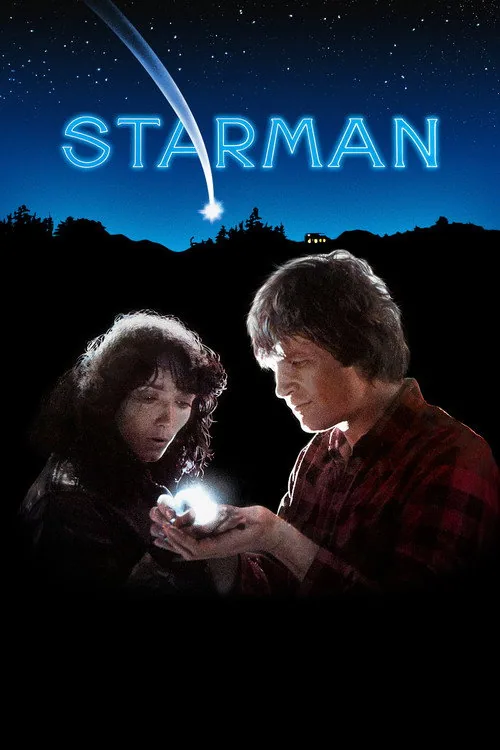
Jenny helps an alien in her late husband's likeness reach a meeting point before the authorities can capture him.
Why this matches +
Related viewing experiences with the specific differences recorded for each pair.
An adjacent discovery: a related idea with a different viewing experience.
Genres: Science fiction / Romance
Shared film traits
Based on recorded story, mood and style. Your preferences can change the order.
What changes A gentle apparent outsider changes a grieving human’s understanding of loss and belonging; an openly alien road romance supplies physical pursuit where the source holds identity uncertain inside institutional interviews.
After a peaceful alien probe is shot down, its lone visitor finds the home of Jenny Hayden, a widow still grieving her husband. The being uses a lock of Scott's hair to create a human body and asks Jenny to help him travel across the country to reach a rendezvous point. Pursued by government agents, the unlikely pair share a road journey that changes Jenny's understanding of loss and the visitor's understanding of humanity. John Carpenter's science-fiction romance combines pursuit with a gentle first-contact story.
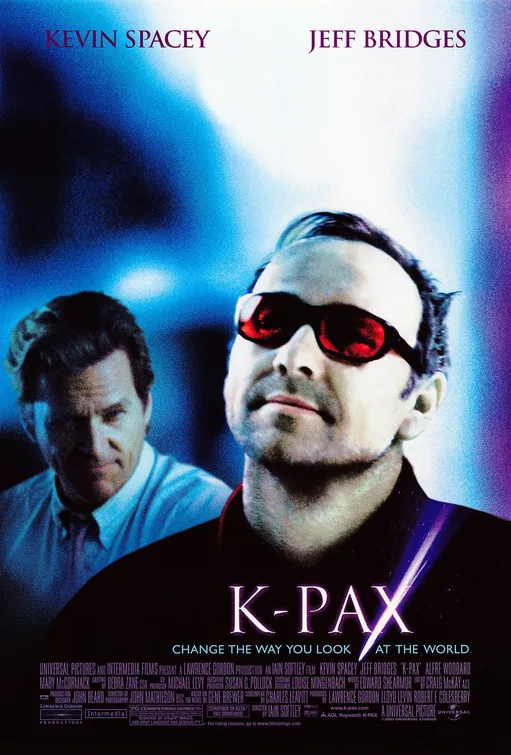
A man calling himself Prot arrives in a Manhattan psychiatric hospital and calmly says he is an alien from the planet K-PAX. Psychiatrist Mark Powell treats the claim as a case to investigate, while Prot’s composure and knowledge unsettle the clinic’s routines and attract other patients. Interviews and experiments gather clues without deciding whether the visitor is extraterrestrial or a traumatized human whose identity has fractured. The question becomes harder when other patients appear to improve around him, but their changes do not function as clinical proof of an alien cause. The film’s mystery depends on holding competing readings open; its depiction of psychiatric diagnosis and treatment is a speculative dramatic device, not a guide to real clinical practice.
What drives the story
Powell’s effort to identify Prot’s past alternates with the patient’s own timetable for departure. The investigation collects suggestive details but never produces a neutral test that settles the alien-versus-trauma interpretation.
The people at its centre
Powell’s professional confidence is gradually entangled with his own family history, while Prot’s effect on fellow patients raises the possibility of care without explaining its mechanism. The ensemble’s recovery claims should stay within the film’s ambiguity.
What it feels like
Clinical interviews, restrained science-fiction clues and dry humor keep the film between hospital drama and visitation mystery. Its measured pace offers emotional curiosity rather than the escalation of a conventional invasion plot.
Worth knowing
The final identity remains unresolved by design. Compare with ambiguous science fiction about belief and trauma, not as a realistic portrayal of psychosis, forensic assessment or what treatment can establish.