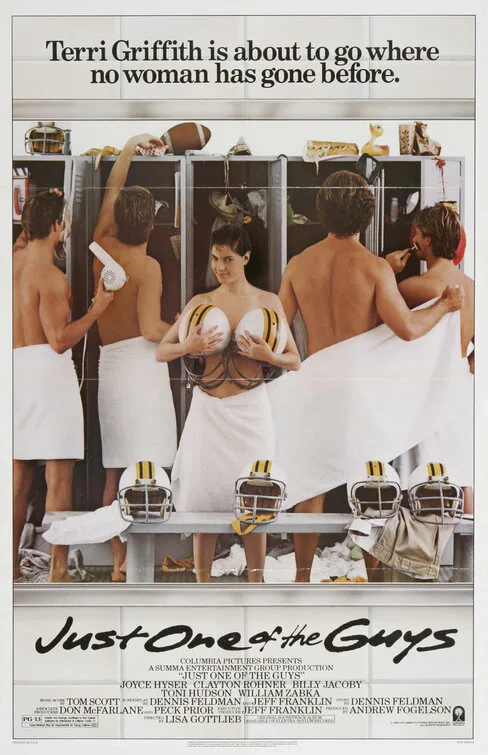
Terri changes schools under a false identity to test whether her work will be taken seriously.
Why this matches +
Selected for the central appeal: Teen comedies about mistaken identity, competition and unexpected romantic complications.
Genres: Romance / Comedy
Shared film traits
Based on recorded story, mood and style. Your preferences can change the order.
Coming of age
What changes A teenage girl enrolls as a boy to challenge sexist assumptions and becomes entangled in unexpected romantic feelings; journalism and a more adult 1980s teen-comedy sensibility replace soccer and twin impersonation.
Aspiring journalist Terri Griffith believes teachers dismiss her work because she is a girl, so she enrolls at another school disguised as a boy. The experiment gives her access to a new peer group and a chance to investigate gender bias, but keeping the secret complicates her friendships and romantic feelings. The comedy borrows a mistaken-identity structure to examine how people respond to gender and status.
A school transfer gives Dizzy the chance to manufacture a new reputation, but success makes honesty increasingly difficult.
Why this matches +
Related viewing experiences with the specific differences recorded for each pair.
An adjacent discovery: a related idea with a different viewing experience.
Genres: Comedy
Shared film traits
Based on recorded story, mood and style. Your preferences can change the order.
Coming of age
What changes The New Guy follows a teenager adopting a new identity to change his place at school, with a reinvention scheme rather than Viola impersonating her twin to play soccer.
A socially awkward student gets expelled and decides to start over at a new school with a tougher identity. Advice from an unlikely mentor helps him construct the persona of a confident outsider, but the reinvention attracts attention and relationships that make the deception harder to maintain. The teen comedy follows how performance can open doors while also creating the fear of being known as the person one was trying to leave behind.
a copied routine requiring an original performance before nationals. This pressure determines what the protagonist must do next and which risks become unavoidable.
Why this matches +
Related viewing experiences with the specific differences recorded for each pair.
An adjacent discovery: a related idea with a different viewing experience.
Genres: Comedy / Romance
Shared film traits
Based on recorded story, mood and style. Your preferences can change the order.
Sport and competition · Coming of age
What changes Bring It On follows young women confronting rivalry and expectations in a school sport, using cheerleading and team competition without Viola's impersonation.
A new captain of a championship cheer squad learns that the team’s winning routine was taken from a rival school. With a national competition approaching, she must confront the squad’s borrowed success and build a performance of its own. The comedy treats cheerleading as athletic work and public spectacle, following teenagers negotiating rivalry, fairness and pressure to defend a school’s reputation.
When Viola’s school cuts its girls’ soccer team, she tries to join the boys’ side and is dismissed by the coach and her boyfriend. Her twin Sebastian leaves for London without enrolling at his new boarding school, so Viola disguises herself as him and takes his place to prove she can compete. At Illyria she becomes roommates with captain Duke, who is drawn to “Sebastian” while asking for help with Olivia, who likes the real Sebastian. The impersonation turns a team tryout into a farce about gender, confidence and crossed affections.
What drives the story
The disguise lets Viola enter a team that rejected her openly, but its success depends on managing an increasingly tangled chain of mistaken attraction.
The people at its centre
Viola’s goal is competitive recognition, not simply romance; Duke’s friendship with the person he thinks is Sebastian makes the comedy test what he values beyond appearances.
What it feels like
Fast reactions, physical comedy and soccer practice keep the Shakespearean mistaken-identity plot buoyant, with the boarding-school team giving the romance a shared arena.
Worth knowing
Best for teen romantic comedies built around disguise, sport and Shakespearean confusion; its appeal is broad farce rather than realistic treatment of gender discrimination.