Explore films connected to Strange Darling through Perspective and assumption, Violence and trust, Narrative control. Choose the qualities you want to carry into your next watch.
What should feel similar?
Find your next favourite
9 films · Closest overall matches
Hide films you’ve seen or don’t want. Saved on this device.
No matches for this combination yet.
Try another option or reset your choices to see more films.
Based on recorded story, mood and style. Your preferences can change the order.
Investigation
What changes Strange Darling: nonlinear chapter structure, immediate thriller tension and recontextualizing revelations. Insomnia: measured and escalating.
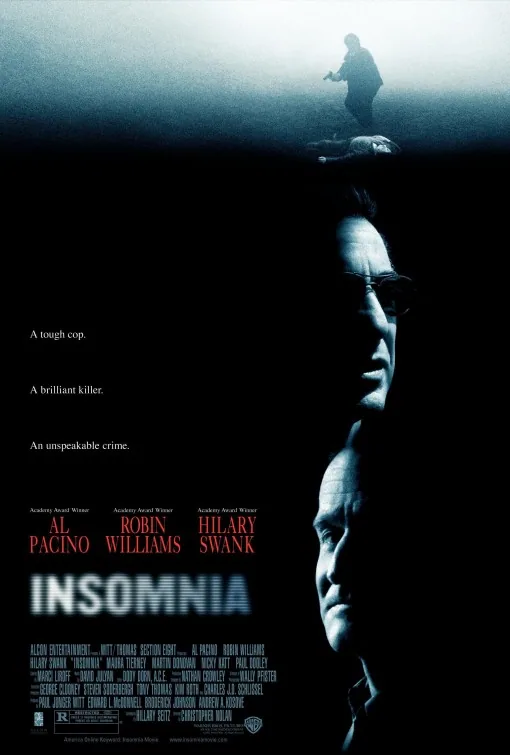
An experienced detective travels to an Alaskan town to investigate a teenager's murder while his own professional conduct faces scrutiny. A fatal mistake during pursuit gives the killer leverage, and the detective's attempt to hide it makes solving the original crime inseparable from protecting himself. Continuous daylight and sleeplessness erode the certainty he once embodied for a younger local officer. The thriller places investigation under a corrosive conflict: the person needed to expose one wrongdoing is actively concealing another.
Based on recorded story, mood and style. Your preferences can change the order.
Investigation
What changes Strange Darling: nonlinear chapter structure, immediate thriller tension and recontextualizing revelations. Identity: escalating and concentrated.
A storm strands a group of strangers at a remote motel, where a sequence of murders makes each person’s identity and story seem less secure. A parallel legal proceeding follows a condemned man whose case may hold the key to the events. The thriller uses a closed setting, shifting clues and intersecting timelines to turn a murder mystery into a puzzle about perception.
Based on recorded story, mood and style. Your preferences can change the order.
Investigation
What changes Strange Darling: nonlinear chapter structure, immediate thriller tension and recontextualizing revelations. 11:14: mystery opening, short interlocking chapters and reveal-driven convergence.
At 11:14 p.m. in a small town, a car strikes a body and a sequence of seemingly unrelated events begins to unravel. The film rewinds through overlapping stories involving teenagers, a night-shift worker, a family, and a group of young criminals, with each section exposing what happened a few minutes earlier. As the accounts fold back toward the same pair of accidents, ordinary lies and impulsive choices explain how the night reached its grisly turning point.
Based on recorded story, mood and style. Your preferences can change the order.
Investigation
What changes Strange Darling: nonlinear chapter structure, immediate thriller tension and recontextualizing revelations. The Usual Suspects: slow burn.
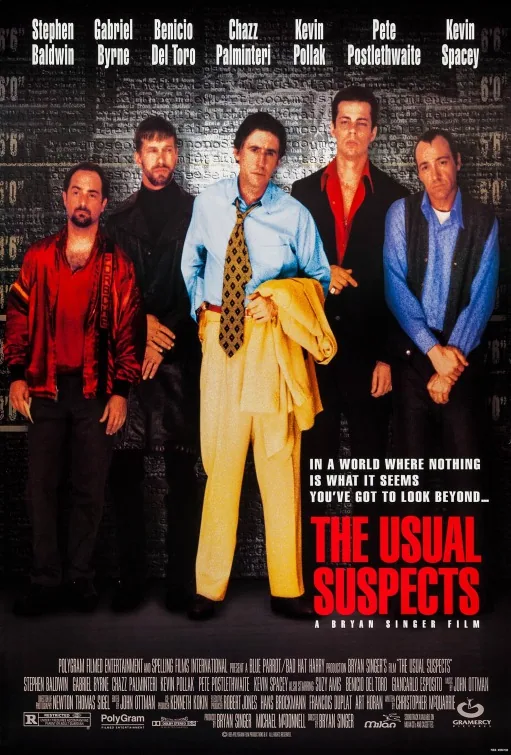
A wounded survivor recounts how a group of criminals met through a police lineup and became involved in jobs linked to a seemingly untouchable underworld figure. An investigator tries to turn that testimony into a coherent explanation for a deadly harbour incident. The account's persuasive details create a sense of structure while the conditions under which it is being told make certainty about motives and events increasingly precarious.
Based on recorded story, mood and style. Your preferences can change the order.
Investigation
What changes Strange Darling: nonlinear chapter structure, immediate thriller tension and recontextualizing revelations. Max Payne: propulsive and set-piece driven.
A New York detective searches for the people responsible for the deaths of his family and partner, following clues through a criminal network tied to a powerful drug. Hallucinations and stylized visual sequences complicate his investigation, while the pursuit pushes him toward increasingly dangerous confrontations. The action adaptation combines noir atmosphere with comic-book imagery and a revenge plot.
Based on recorded story, mood and style. Your preferences can change the order.
Investigation
What changes Strange Darling: nonlinear chapter structure, immediate thriller tension and recontextualizing revelations. Bad Times at the El Royale: interlocking character chapters.
Seven strangers arrive at a once-fashionable hotel divided by the California–Nevada border, each carrying a story they would rather keep private. The manager’s hidden surveillance system turns the rooms and corridors into a maze of observation, while secrets connect several guests to danger outside the property. Drew Goddard’s crime thriller unfolds over one night, shifting perspective between characters and using the hotel’s divided layout as a stage for suspicion, reversals, and moral choices.
Based on recorded story, mood and style. Your preferences can change the order.
Escape and pursuit · Investigation
What changes Strange Darling: nonlinear chapter structure, immediate thriller tension and recontextualizing revelations. A Perfect Getaway: slow-burn suspicion, clue-driven and thriller payoff.
Newlyweds Cliff and Cydney travel to Hawaii for a hiking honeymoon just as news spreads that a couple has been murdered on one of the islands. On the trail they meet other visitors, and casual conversation turns into suspicion as the travelers try to decide whom they can trust. The remote landscape both attracts them and limits their choices, while the film gradually reframes what viewers know about the group. This twist-driven thriller uses the conventions of a vacation adventure to explore identity, performance, and danger among strangers.
Based on recorded story, mood and style. Your preferences can change the order.
Investigation
What changes Strange Darling: nonlinear chapter structure, immediate thriller tension and recontextualizing revelations. Mortal Thoughts: an investigation reconstructs a troubled relationship.
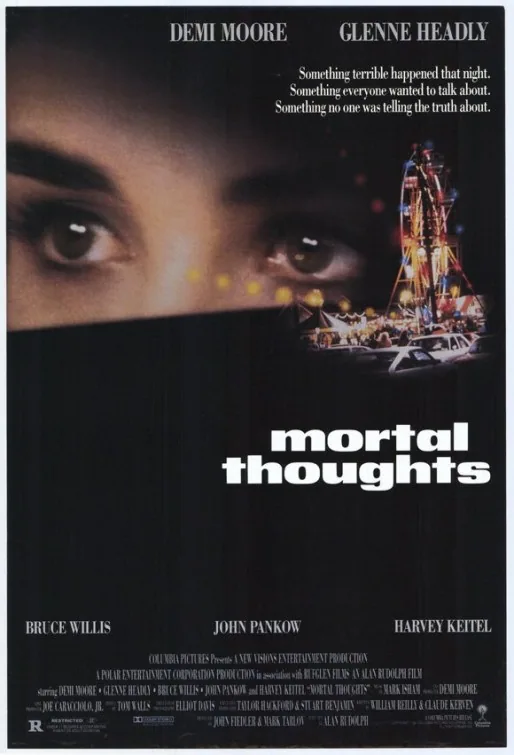
Two women who have been close friends become entangled in the murder investigation of the husband of one of them. Their accounts of the past and of the crime do not remain consistent, forcing investigators and the audience to question what each woman is protecting. Alan Rudolph's thriller uses shifting testimony and personal intimacy to unsettle the boundary between loyalty and complicity.
Based on recorded story, mood and style. Your preferences can change the order.
What changes Strange Darling: nonlinear chapter structure, immediate thriller tension and recontextualizing revelations. Pulp Fiction: steady and intense.
Intersecting episodes follow two hired killers, a boxer who refuses an arranged defeat, and people caught around a Los Angeles crime boss. An evening escort assignment, a mysterious briefcase and an accidental shooting turn routine professional obligations into crises requiring improvisation. By presenting these encounters out of chronological order, the film lets survival, humiliation and an unexpected possibility of moral change recur across a world of casual criminal conversation.
A one-night encounter between two strangers in Oregon turns into a violent chase through the countryside. The film presents the events in six chapters arranged out of chronological order, allowing encounters and apparent motives to change meaning as more information emerges. JT Mollner’s thriller stars Willa Fitzgerald and Kyle Gallner and is designed around perspective, expectation, and withheld context. A plot-specific profile should preserve its reversals and avoid disclosing which assumptions the film intends to unsettle.
What drives the story
Two people’s encounter becomes a dangerous pursuit whose sequence is rearranged to control what viewers know and when.
The people at its centre
The relationship between the central pair changes with each chapter, and the viewer must reassess how threat and vulnerability are assigned.
What it feels like
A suspenseful, deliberately nonlinear thriller uses chapter breaks and visual style to make withheld context part of the experience.
Worth knowing
Its effect depends on perspective shifts and spoilers, so the profile stays at the level of structure and premise.
Perspective and assumptionViolence and trustNarrative control