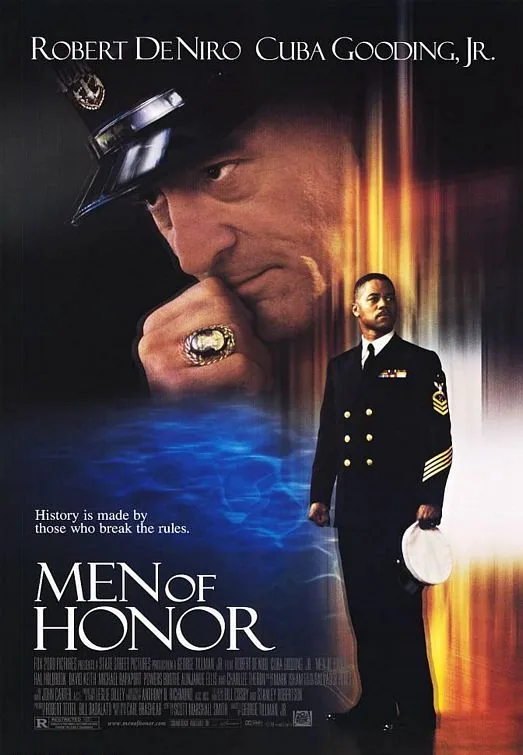
The qualification process turns repeated physical tests into a measure of whether the institution will recognize Brashear’s ability.
Why this matches +
Selected for the central appeal: Inspirational historical dramas about overcoming discrimination through professional skill and collective support.
Genres: Biography / Drama
Shared film traits
Based on recorded story, mood and style. Your preferences can change the order.
What changes Men of Honor follows a Black serviceman overcoming institutional racism to pursue a demanding professional role.
Carl Brashear joins the United States Navy’s diving program and faces entrenched discrimination as he pursues qualification as a master diver. His demanding training relationship with instructor Billy Sunday combines personal conflict with institutional barriers. The biographical drama follows Brashear’s persistence through physical setbacks and professional resistance toward a career-defining test.
A series of increasingly consequential flight tests moves toward the lunar mission, while bereavement and workplace losses make emotional containment harder to sustain. Mission procedures give grief no neat outlet; work contains it without resolving it.
Why this matches +
These offer a related experience with a meaningful difference in story, tone, or presentation.
An adjacent discovery: a related idea with a different viewing experience.
Genres: Drama / Biography
Shared film traits
Based on recorded story, mood and style. Your preferences can change the order.
Space exploration
What changes First Man portrays NASA's space-race work and the personal sacrifices behind its technical achievements.
Neil Armstrong enters the space program after the death of his young daughter, bringing a test pilot’s focus to a sequence of missions that repeatedly endanger colleagues. NASA’s technical achievement advances through small procedural decisions and fragile machinery, while the family experiences each launch as an interval of uncertain waiting. Janet asks Neil to explain that risk to their children; his reserved manner cannot make grief or professional danger disappear. The film’s close cockpit imagery resists a purely panoramic victory narrative, but its imagined private gestures should not be confused with evidence of Armstrong’s inner life.
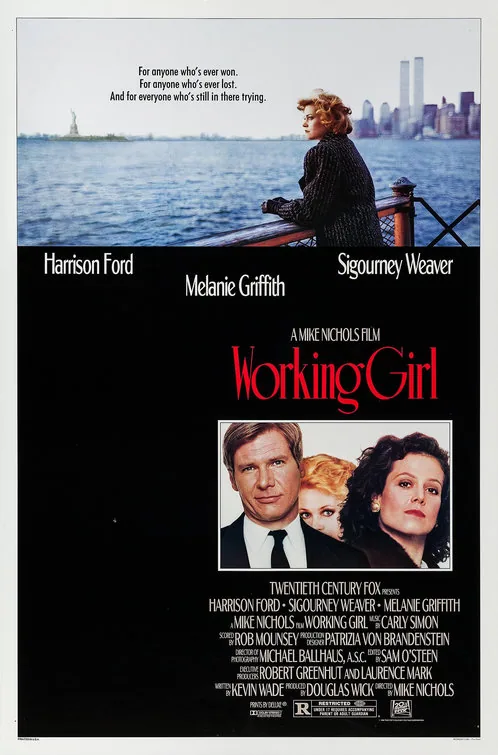
A stolen business idea drives an unauthorized impersonation that gives an overlooked employee a chance to prove herself.
Why this matches +
These offer a related experience with a meaningful difference in story, tone, or presentation.
An adjacent discovery: a related idea with a different viewing experience.
Genres: Comedy / Romance
Shared film traits
Based on recorded story, mood and style. Your preferences can change the order.
What changes Working Girl follows a capable woman challenging workplace barriers and seeking recognition for her ideas.
Tess, a secretary with business ambitions, develops an acquisition idea that her sophisticated boss claims as her own. When that boss is injured, Tess borrows the office, clothes, and authority needed to pitch the deal herself. Her professional gamble becomes entangled with romance, exposing how presentation and class determine whose intelligence is recognized in a corporate hierarchy.
Ann Atwater and C. P. Ellis are asked to lead community meetings on school desegregation despite their opposing positions.
Why this matches +
These offer a related experience with a meaningful difference in story, tone, or presentation.
An adjacent discovery: a related idea with a different viewing experience.
Genres: Biography / Drama
Shared film traits
Based on recorded story, mood and style. Your preferences can change the order.
What changes The Best of Enemies follows people confronting racial segregation and building an unexpected working relationship.
In 1971 Durham, North Carolina, civil-rights organizer Ann Atwater campaigns for better conditions for Black residents while segregation shapes the schools and public life. After a school fire intensifies local conflict, organizer Bill Riddick asks Ann and Ku Klux Klan leader C. P. Ellis to co-chair a series of community meetings about desegregation. The dramatized account follows their antagonism, the deliberations, and the personal and political pressures surrounding the vote.
Rustin organizes a national march while negotiating with allies, political leaders and opponents who seek to limit his influence.
Why this matches +
These offer a related experience with a meaningful difference in story, tone, or presentation.
An adjacent discovery: a related idea with a different viewing experience.
Genres: Biography / Drama
Shared film traits
Based on recorded story, mood and style. Your preferences can change the order.
What changes Rustin follows a skilled Black organizer whose contributions face prejudice and institutional obstacles.
Bayard Rustin is an experienced organizer whose commitment to nonviolent protest and racial equality shapes the planning of the 1963 March on Washington. Although his strategic ability is crucial, his sexuality and past political associations leave him vulnerable to attacks from opponents and uneasy allies. George C. Wolfe’s drama follows Rustin as he builds coalitions with A. Philip Randolph, Martin Luther King Jr. and a wide network of activists to turn an ambitious demonstration into a mass event.
At NASA’s segregated Langley center, mathematician Katherine Johnson, computing-unit leader Dorothy Vaughan and aspiring engineer Mary Jackson confront different barriers to work they are qualified to do. The space race creates demand for their expertise but does not automatically grant access, credit or promotion; each woman develops a distinct strategy, and their friendship makes those efforts more sustainable. The film compresses events and invents the composite supervisor Al Harrison. NASA historians have also noted that the famous bathroom walk was a real kind of injustice but not an event that happened to Johnson as shown. The drama’s momentum should not turn institutional change into a gift from one benevolent manager.
What drives the story
Mission demands create openings for expertise while segregated procedures and professional barriers force three women to pursue different routes to access and recognition. The mission deadline creates opportunity, while segregation still shapes who can enter a room and receive credit.
The people at its centre
Johnson’s calculations, Vaughan’s leadership and computing work, and Jackson’s engineering path are distinct; collective support complements rather than replaces their individual agency. Vaughan’s computing leadership, Jackson’s engineering path and Johnson’s calculations should stay distinct.
What it feels like
Clear workplace obstacles, accessible technical scenes and emotional breakthroughs make institutional exclusion legible as an ensemble drama, with some history compressed for narrative momentum. Technical scenes turn abstract workplace exclusion into concrete barriers and procedures.
Worth knowing
Compare with workplace stories of expertise under discrimination, while distinguishing real people from the Harrison composite and the film’s bathroom scene from Johnson’s documented experience. The bathroom episode condenses a real system of segregation but is not a literal Johnson event.
ExpertiseRacismGender inequality
Mood
Earnest · Hopeful · Defiant
Pacing
Steady · Escalating
Visual style
Period workplace detail · Technical demonstrations
Storytelling
Segregated technical work · Parallel professional barriers · Collective preparation