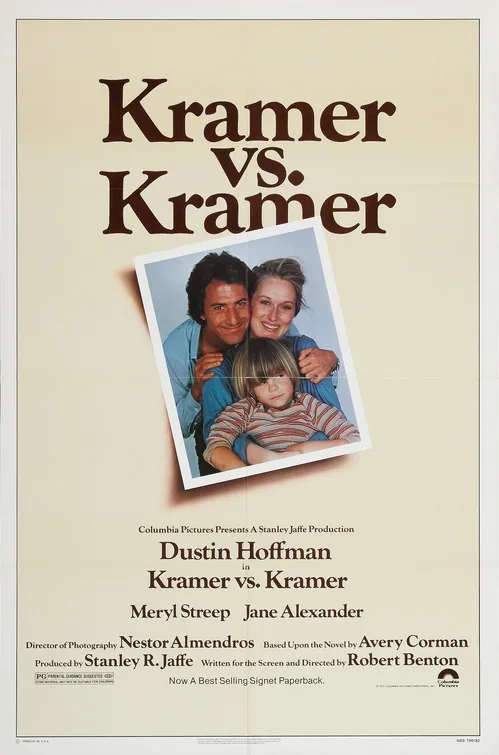
An abrupt change in caregiving exposes the imbalance of a marriage, then a custody dispute converts personal growth into competing public arguments.
Why this matches +
Selected for the central appeal: Family dramas about custody, disability and the support needed to care for a child.
Genres: Drama
Shared film traits
Based on recorded story, mood and style. Your preferences can change the order.
What changes Kramer vs. Kramer follows a parent facing a custody dispute while learning the daily demands of care.
An advertising executive's wife leaves their marriage, forcing him to become the everyday parent to a son whose routines he barely knows. Awkward practical tasks gradually create a deeper relationship, while the demands of his job begin to conflict with care. When the mother returns seeking custody, their private reassessment of family becomes an adversarial legal process that threatens to simplify both parents' motives.
A domestic arrangement produces a disputed incident whose interpretation threatens two families' futures.
Why this matches +
These offer a related experience with a meaningful difference in story, tone, or presentation.
An adjacent discovery: a related idea with a different viewing experience.
Genres: Drama
Shared film traits
Based on recorded story, mood and style. Your preferences can change the order.
What changes A Separation examines caregiving, family separation and the difficult judgments made by legal institutions.
A couple's disagreement about leaving Iran leads to a household separation and the hiring of a caregiver for an elderly father. An incident between the caregiver and the husband produces accusations whose consequences reach both families. Class, religious obligation and partial knowledge complicate every account, while a daughter is pressed to navigate loyalties that the adults cannot reconcile.
The family’s displacement exposes the different futures Will and Tom imagine and the compromises each can accept.
Why this matches +
These offer a related experience with a meaningful difference in story, tone, or presentation.
An adjacent discovery: a related idea with a different viewing experience.
Genres: Drama
Shared film traits
Based on recorded story, mood and style. Your preferences can change the order.
What changes Leave No Trace follows a parent and child whose close bond is tested by authorities' concerns about their living situation.
Will and his teenage daughter Tom have built a quiet life in the forests of Portland, Oregon, living off the grid and relying on practiced routines. When a small mistake brings social services into their lives, the two are moved into a new environment and eventually set out toward the wilderness again. Debra Granik’s restrained drama observes the bond between a protective father and an increasingly independent daughter, asking how care, safety, and belonging can mean different things to each of them without casting their conflict as a simple contest of right and wrong.
A contradictory eligibility decision traps a sick worker between systems, making survival depend on navigating tasks whose completion does not produce timely support.
Why this matches +
These offer a related experience with a meaningful difference in story, tone, or presentation.
An adjacent discovery: a related idea with a different viewing experience.
Genres: Drama
Shared film traits
Based on recorded story, mood and style. Your preferences can change the order.
What changes I, Daniel Blake follows a person seeking fair treatment and support from an impersonal system.
A widowed carpenter unable to resume work after a heart attack is declared fit by a benefits assessment and pushed into requirements that contradict his doctor's advice. Seeking an appeal demands computer skills, repeated explanations and performances of job-seeking that do little to meet his immediate needs. Friendship with a single mother creates a small network of practical care within the same system's failures. The social drama makes administrative delay materially consequential, contrasting ordinary competence and solidarity with procedures that refuse to recognize either.
Jackie’s illness forces the family to confront how the children will be cared for and what Isabel’s place may become.
Why this matches +
These offer a related experience with a meaningful difference in story, tone, or presentation.
An adjacent discovery: a related idea with a different viewing experience.
Genres: Drama / Comedy
Shared film traits
Based on recorded story, mood and style. Your preferences can change the order.
What changes Stepmom follows adults navigating shared caregiving and a child's needs amid changing family circumstances.
After his divorce from Jackie, Luke begins a life with Isabel, a younger photographer who is trying to build a relationship with his children. Jackie resists the changes in her family and doubts Isabel’s ability to care for them. The tension shifts when Jackie receives a terminal cancer diagnosis, forcing both women to reconsider their rivalry and the children’s future. Chris Columbus’s drama follows family adjustment and the difficult transition toward a stepmother role under the pressure of illness.
Sam Dawson faces a custody challenge when his daughter Lucy begins learning and authorities question whether his intellectual disability makes him an adequate parent. His affection is real, but their life also depends on friends and neighbors; the film’s resolution eventually makes shared caregiving more important than the courtroom’s either-or judgment. Rita, the lawyer who takes his case, brings her own difficulty connecting with her son, creating a parallel that can broaden the question of care but also sentimentalize it. The drama challenges a narrow idea of competence while simplifying the practical and legal supports families may need. Love matters here, but the film is not evidence that love alone settles capacity or care.
What drives the story
A custody case makes Sam defend his relationship with Lucy against a system that measures parenting capacity through a narrow, adversarial test. The foster family’s involvement makes support a practical part of parenting rather than a courtroom abstraction.
The people at its centre
Sam and Lucy’s attachment is sustained by a community, while Rita’s strained relationship with her son complicates her professional confidence without making their problems equivalent. Rita’s parallel difficulties prompt empathy but do not equate her situation with Sam’s disability.
What it feels like
Emphatic performances, familiar songs and courtroom confrontations prioritize emotional identification over procedural nuance, creating a sentimental family melodrama. Songs and emotional performances steer viewers toward affection more than legal nuance.
Worth knowing
Compare with custody dramas that question disability bias, while preserving collaborative support and avoiding claims that this film represents all parents with intellectual disabilities or proves affection is sufficient. Critique of bias should not turn this sentimental drama into evidence about capacity or support policy.