Explore films connected to It's Kind of a Funny Story through Mental health, Adolescence, Connection. Choose the qualities you want to carry into your next watch.
What should feel similar?
Find your next favourite
9 films · Closest overall matches
Hide films you’ve seen or don’t want. Saved on this device.
No matches for this combination yet.
Try another option or reset your choices to see more films.
Both share themes of connection, plus a gentle and hopeful atmosphere.
Why this matches +
Genres: Comedy / Drama
Shared film traits
Based on recorded story, mood and style. Your preferences can change the order.
Coming of age
What changes It's Kind of a Funny Story: a short hospital stay provides episodic encounters and gradual change. Lars and the Real Girl: patient and gradual character change.
Lars Lindstrom lives in a small Wisconsin town and finds ordinary closeness difficult after a childhood marked by loss and emotional distance. When he introduces a life-size doll named Bianca as his girlfriend, his brother and sister-in-law seek help from the community rather than humiliating him. The gentle comedy follows the town’s effort to support Lars while he works through his attachment and gradually becomes more open to other people.
Based on recorded story, mood and style. Your preferences can change the order.
Coming of age
What changes It's Kind of a Funny Story: a short hospital stay provides episodic encounters and gradual change. Love, Simon: brisk.
A closeted teenager finds an anonymous correspondent who makes disclosure feel possible before he is ready for it publicly. A classmate's discovery of the messages turns privacy into leverage, and attempts to satisfy the blackmailer damage friendships that had offered genuine support. Searching for the correspondent's identity becomes entangled with deciding when and how to speak in his own name. The romantic comedy treats coming out as a question of agency as well as recognition, while allowing the desire for safety to produce choices requiring repair.
Based on recorded story, mood and style. Your preferences can change the order.
What changes It's Kind of a Funny Story: a short hospital stay provides episodic encounters and gradual change. Funny People: gradual and character-led.
A successful comedian learns that he has a serious illness and hires a younger performer to help write jokes, creating an unlikely working friendship. As treatment changes his outlook, he revisits former relationships and considers what success has cost him. The drama-comedy links performance to mortality, showing how the ability to make an audience laugh can coexist with loneliness and the need to repair personal connections.
Based on recorded story, mood and style. Your preferences can change the order.
What changes It's Kind of a Funny Story: a short hospital stay provides episodic encounters and gradual change. Next Friday: episodic and escalating.
After a confrontation at home, Craig spends time with his uncle Elroy in a suburban neighborhood where a local bully and his crew continue to cause trouble. The visit brings him together with a different circle of family and friends, while old rivalries and new schemes turn ordinary errands into comic standoffs. The sequel keeps its focus on neighborhood loyalty and improvised problem solving, moving the Friday-series humor into a new setting.
Based on recorded story, mood and style. Your preferences can change the order.
Coming of age
What changes It's Kind of a Funny Story: a short hospital stay provides episodic encounters and gradual change. St. Vincent: measured character comedy with emotional turns.
A lonely boy forms an unexpected bond with his elderly neighbor, a hard-drinking man whose rough manners conceal grief, debt and a complicated past. What begins as an after-school arrangement becomes a mentorship that changes how both see their lives. The comedy balances abrasive humor with tenderness, asking whether care can come from people who do not fit an idealized image of a role model.
Based on recorded story, mood and style. Your preferences can change the order.
Coming of age
What changes It's Kind of a Funny Story: a short hospital stay provides episodic encounters and gradual change. The Kings of Summer: episodic, summer interlude and character-led.
Frustrated by his father’s attempts to manage his life, teenager Joe Toy runs away with his friend Patrick and an eccentric boy named Biaggio. The trio build a makeshift house in the woods and attempt to live independently through the summer. Their self-sufficiency is tested by practical problems, friendship tensions, and growing feelings for a girl from town. Jordan Vogt-Roberts’s coming-of-age comedy observes the appeal and limits of escape from family as boys try to define adulthood for themselves.
Based on recorded story, mood and style. Your preferences can change the order.
Coming of age
What changes It's Kind of a Funny Story: a short hospital stay provides episodic encounters and gradual change. Parenthood: ensemble-paced and varied.
The Buckman family members confront very different pressures as parents, partners, and children returning to old family patterns. Gil worries that he is failing his own children, while his siblings struggle with ambition, relationships, and expectations passed down between generations. Their stories intertwine through comic household crises, showing how family life can be loving and sustaining even when no one has a reliable plan.
Based on recorded story, mood and style. Your preferences can change the order.
What changes It's Kind of a Funny Story: a short hospital stay provides episodic encounters and gradual change. The Station Agent: unhurried, conversation-led and low-key.
Finbar McBride, a private man with a passion for trains, inherits an abandoned station in rural New Jersey and hopes to live there alone. His quiet routine is interrupted by Joe, an outgoing vendor whose stand is nearby, and Olivia, an artist coping with a recent family loss. Although the three begin with different needs and little in common, repeated encounters build a tentative friendship. Tom McCarthy’s comedy-drama gives attention to silence, loneliness, and the awkward process of allowing other people into a life organized around solitude.
Based on recorded story, mood and style. Your preferences can change the order.
Coming of age
What changes It's Kind of a Funny Story: a short hospital stay provides episodic encounters and gradual change. Dan in Real Life: conversational and episodic.
A widowed advice columnist meets a woman he likes, only to learn she is dating his brother during a family weekend. The crowded gathering forces Dan to balance his private feelings with the needs of his daughters and siblings. The dramedy finds new love difficult because it arrives within an existing network of care and grief. Naturalistic family conversations and a gently awkward tone favor emotional observation over big romantic gestures.
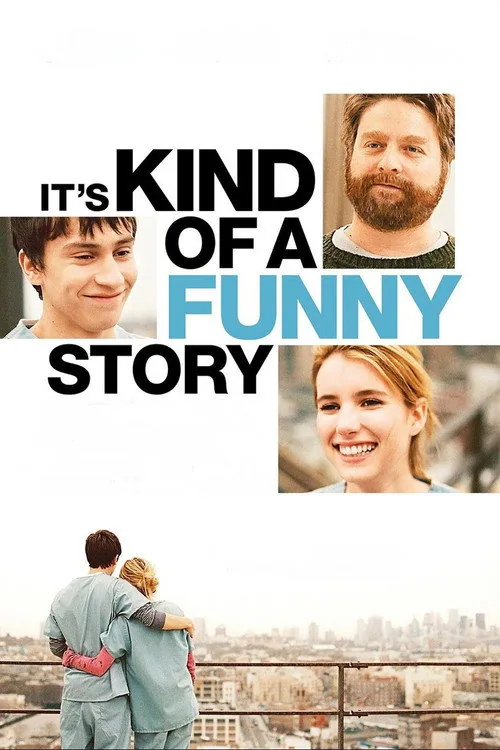
Depressed teenager Craig Gilner asks for urgent help and is admitted to an adult psychiatric ward after the adolescent unit closes temporarily. Over several days, he forms relationships with fellow patients, including Bobby, and reconnects with his interests while confronting school pressure, family expectations, and his feelings for his friend Nia. The comedy-drama treats hospitalization as a pause that makes room for honesty and connection, balancing humor with the seriousness of Craig’s crisis.
What drives the story
Craig’s decision to seek help places him in a temporary community that changes how he views his problems and abilities.
The people at its centre
Bobby’s care for his daughter and Craig’s tentative closeness with Noelle reveal different ways people carry needs outside the ward.
What it feels like
The film addresses suicidal thoughts and depression with comic warmth; its subject still calls for a thoughtful viewing choice.
Worth knowing
It is a teen mental-health comedy-drama centered on one hospital stay, not a clinical account or a romance set primarily at school.
Mental healthAdolescenceConnection
Mood
Gentle · Reflective · Hopeful
Pacing
A short hospital stay provides episodic encounters and gradual change
Visual style
Colorful subjective imagery · Ordinary hospital spaces · New York city scenes
Storytelling
Teen psychiatric ward · Peer relationships · School pressure