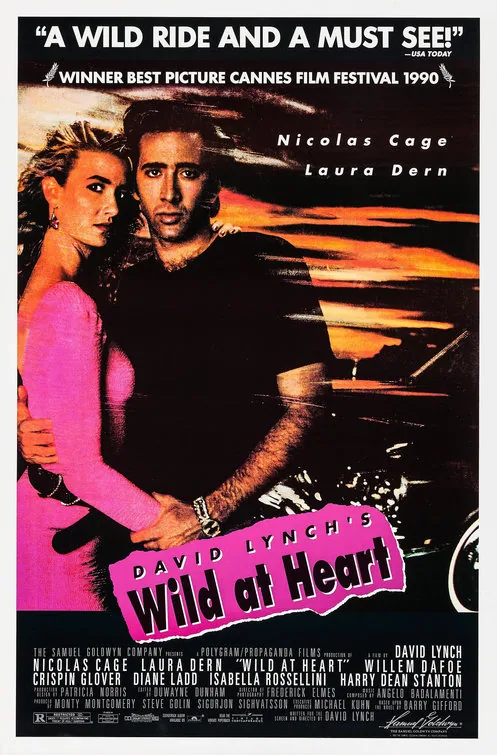
The road offers the lovers a chance at freedom, but Lula’s family history and the people they encounter keep turning escape into danger.
Why this matches +
Selected for the central appeal: Stylized crime stories about violent lovers, media spectacle and the glamorization of notoriety.
Genres: Crime / Drama
Shared film traits
Based on recorded story, mood and style. Your preferences can change the order.
Escape and pursuit
What changes Wild at Heart follows violent lovers on the run through a surreal, highly stylized American landscape.
After leaving prison, Sailor Ripley reunites with Lula Fortune, and the couple set out on the road while Lula’s mother tries to separate them by hiring a killer. Their journey crosses a violent Southern landscape of unstable strangers, impulsive choices and pop-cultural fantasies. Sailor’s devotion to Elvis-style performance and Lula’s imagined Wizard of Oz references give their romance a deliberately heightened, dreamlike frame. David Lynch adapts Barry Gifford’s novel as a story of outlaw love that is repeatedly interrupted by menace and grotesque comedy. Their loyalty is sincere, but grotesque disruptions undercut their romantic ideals. Encounters with violent strangers keep the road from settling into a safe couple's getaway.
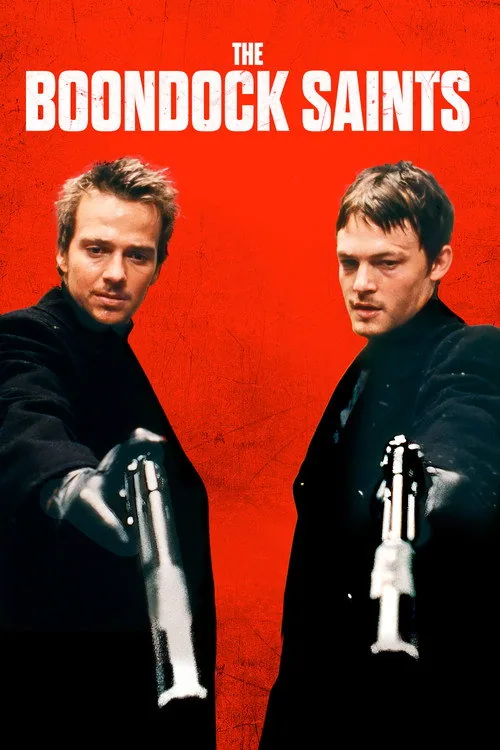
A violent encounter gives the twins a self-appointed mission, while an investigator tries to understand and contain their actions.
Why this matches +
These offer a related experience with a meaningful difference in story, tone, or presentation.
An adjacent discovery: a related idea with a different viewing experience.
Genres: Action / Crime
Shared film traits
Based on recorded story, mood and style. Your preferences can change the order.
Criminal underworld
What changes The Boondock Saints follows killers whose violent campaign becomes a public and media phenomenon.
After Irish American twins Connor and Murphy kill two Russian mobsters in a Boston pub fight, the brothers come to see themselves as called to purge the city’s criminal underworld. An FBI agent investigates their increasingly public attacks while the twins recruit their friend Rocco into the campaign. The film turns a crime story into a stylized debate about vigilante justice, faith, loyalty, and the spectacle of violence.
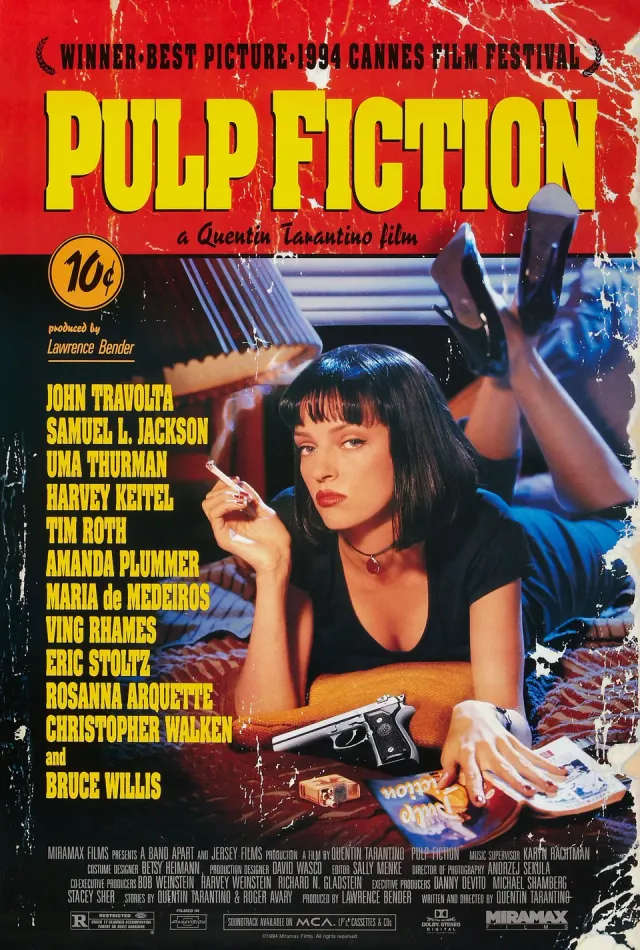
Criminal errands repeatedly derail, and the rearranged chronology makes chance encounters and small decisions reshape the meaning of earlier scenes.
Why this matches +
These offer a related experience with a meaningful difference in story, tone, or presentation.
An adjacent discovery: a related idea with a different viewing experience.
Genres: Crime / Drama
Shared film traits
Based on recorded story, mood and style. Your preferences can change the order.
Criminal underworld
What changes Pulp Fiction combines stylized criminal violence, pop-cultural dialogue and fractured storytelling.
Intersecting episodes follow two hired killers, a boxer who refuses an arranged defeat, and people caught around a Los Angeles crime boss. An evening escort assignment, a mysterious briefcase and an accidental shooting turn routine professional obligations into crises requiring improvisation. By presenting these encounters out of chronological order, the film lets survival, humiliation and an unexpected possibility of moral change recur across a world of casual criminal conversation.
The attackers control the family through arbitrary rules that deny them a reliable path to escape.
Why this matches +
These offer a related experience with a meaningful difference in story, tone, or presentation.
An adjacent discovery: a related idea with a different viewing experience.
Genres: Crime / Drama
Shared film traits
Based on recorded story, mood and style. Your preferences can change the order.
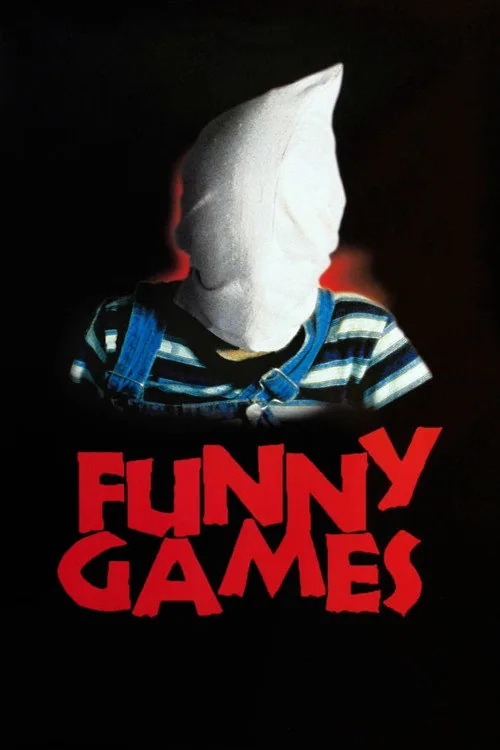
What changes Funny Games confronts viewers with the spectacle of violence and the conventions that make it entertainment.
Georg and Anna Schober arrive with their son at their lakeside holiday home, where two polite young men ask to borrow eggs and gradually take control of the house. The intruders force the family into a series of cruel games and bets about how long they will survive. Michael Haneke’s Austrian thriller repeatedly breaks ordinary suspense conventions, including by making one attacker acknowledge the camera and the audience’s expectations. The film turns a home-invasion story into a confrontational study of spectatorship, violence, and the desire for a satisfying rescue.
Peterson’s violence repeatedly turns attempts at freedom into renewed incarceration and a more elaborate public identity.
Why this matches +
These offer a related experience with a meaningful difference in story, tone, or presentation.
An adjacent discovery: a related idea with a different viewing experience.
Genres: Biography / Crime
Shared film traits
Based on recorded story, mood and style. Your preferences can change the order.
Criminal underworld
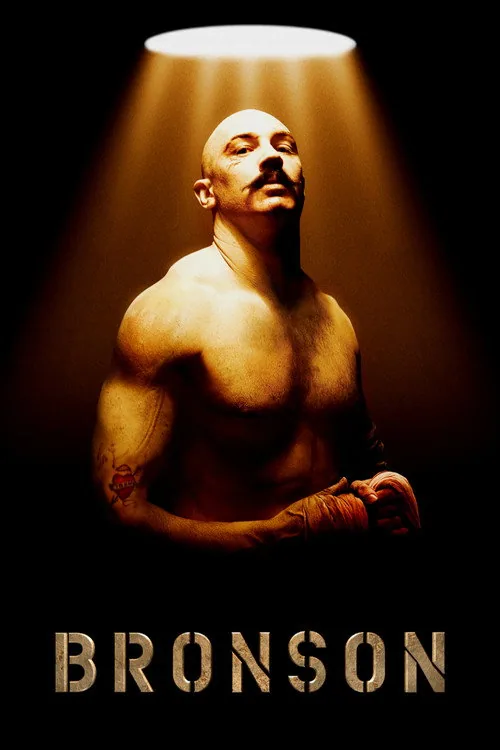
What changes Bronson follows a violent criminal whose persona and notoriety become a theatrical performance.
Michael Peterson, later known as Charles Bronson, recounts a life shaped by prison violence, brief releases, and repeated hostage-taking. He performs parts of his story from a vaudeville stage, addressing the viewer while episodes move between institutions, family memories, and a short-lived attempt at life outside prison. Nicolas Winding Refn’s stylized biographical film treats Peterson’s self-created persona as both spectacle and confinement, without presenting his violence as a triumphant model of rebellion.
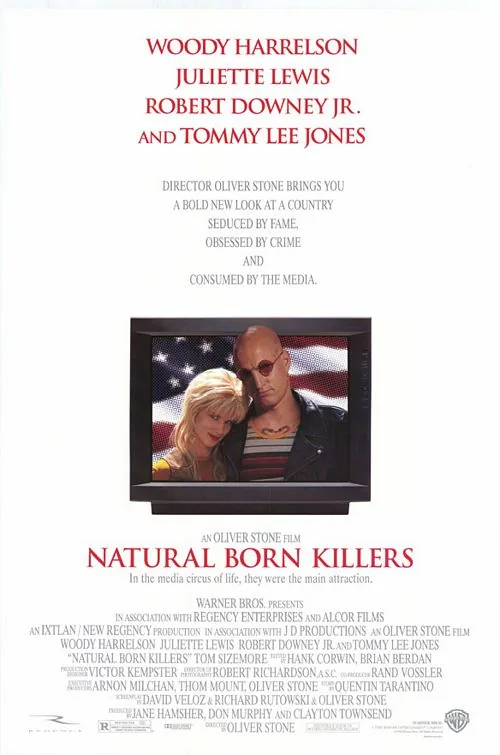
Mickey and Mallory Knox begin a cross-state murder spree after fleeing abusive family histories and bonding through violence. Detective Jack Scagnetti pursues them while concealing his own violent past, and television host Wayne Gale turns the couple into a sensational media phenomenon. After a brief encounter with a Navajo man who shelters them, their capture leads to prison and a televised interview that becomes another volatile confrontation. The film's shifting visual styles and media parody ask how criminal violence is packaged as entertainment even as the central couple remain responsible for their brutality.
What drives the story
The pursuit is also a feedback loop: killings generate media attention, and coverage strengthens the celebrity myth that keeps the spree in public view.
The people at its centre
Mickey and Mallory's intimacy includes loyalty and abuse; Gale's opportunism and Scagnetti's hypocrisy expose how spectators and authorities can share the violence they condemn.
What it feels like
Abrupt shifts among film stocks, animation, sitcom pastiche and news imagery make the viewing experience intentionally abrasive and unstable.
Worth knowing
It is a violent satire about crime and media spectacle, not a straightforward couple-on-the-run thriller or an endorsement of its antiheroes.