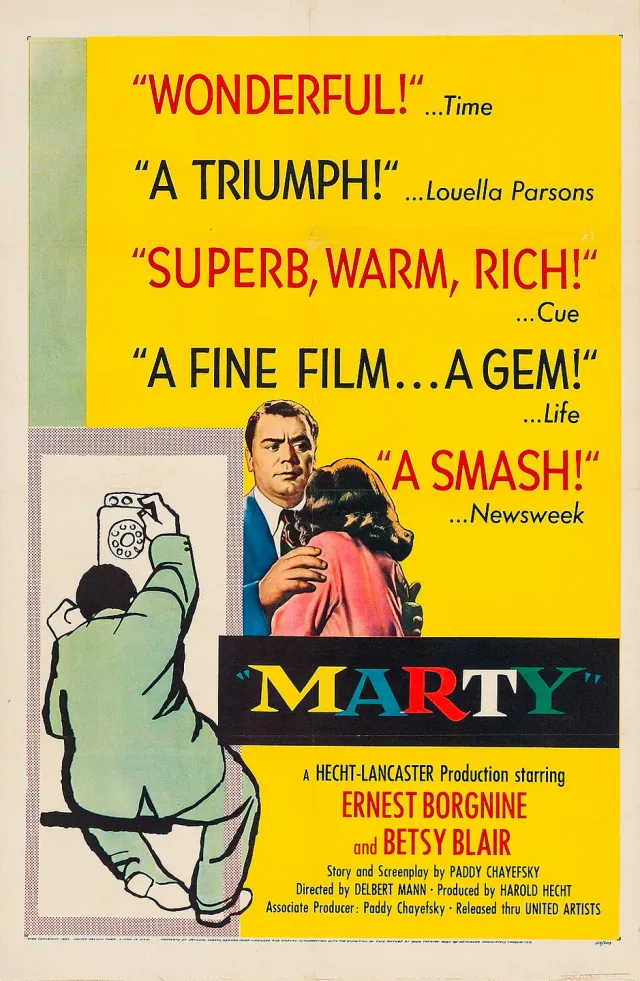
A chance meeting gives a lonely man an opening for intimacy, but his friends' ridicule and his mother's dependence pressure him to abandon it.
Why this matches +
Selected for the central appeal: Bittersweet stories about a resilient woman seeking love and dignity despite disappointment.
Genres: Drama / Romance
Shared film traits
Based on recorded story, mood and style. Your preferences can change the order.
What changes Marty follows a lonely person seeking a sincere relationship despite social judgment and insecurity.
Marty Piletti is a thirty-four-year-old Bronx butcher who still lives with his widowed mother and has nearly given up hope of finding a partner. At a dance hall he meets Clara, a shy teacher whose friends have left, and the two discover an easy connection in a night of conversation and dancing. Marty initially keeps the relationship quiet because he expects ridicule from his friends and worries about leaving his mother alone. When Clara is treated as an embarrassment by his social circle, he has to decide whether companionship matters more than their approval.
An episodic passage through fashionable and intimate encounters repeatedly raises possibilities of meaning that the protagonist observes more readily than he sustains.
Why this matches +
These offer a related experience with a meaningful difference in story, tone, or presentation.
An adjacent discovery: a related idea with a different viewing experience.
Genres: Drama / Comedy
Shared film traits
Based on recorded story, mood and style. Your preferences can change the order.
What changes La Dolce Vita shares Fellini's Rome and examines the gap between glamorous encounters and emotional fulfillment.
A journalist moves through Rome's celebrity circles, private parties and spiritual spectacles, hoping that proximity to extraordinary people will supply the meaningful life his own work keeps postponing. Encounters with lovers, an older intellectual and his visiting father offer different visions of intimacy and success. Their fragmentation exposes a growing inability to turn experience into commitment as entertainment, exhaustion and loneliness become difficult to distinguish.
Two time-separated chapters make private choices accumulate into different adult lives, asking whether love, work and security can coexist under changing circumstances.
Why this matches +
These offer a related experience with a meaningful difference in story, tone, or presentation.
An adjacent discovery: a related idea with a different viewing experience.
Genres: Drama / Romance
Shared film traits
Based on recorded story, mood and style. Your preferences can change the order.
What changes Moscow Does Not Believe in Tears follows a resilient working woman seeking love after romantic betrayal.
The film follows three provincial young women who share a Moscow workers' dormitory in 1958 and revisits them twenty years later. Katerina's promising romance with television cameraman Rudolf ends in rejection when she becomes pregnant; she raises their daughter while studying and building a career. Lyudmila pursues status through marriage and later faces her husband's alcoholism, while Antonina creates a steady family with Nikolay. In 1978, Katerina is a factory director but lonely. A chance train meeting with toolmaker Gosha begins a new relationship that forces her to reconsider the self-sufficiency she has relied on.
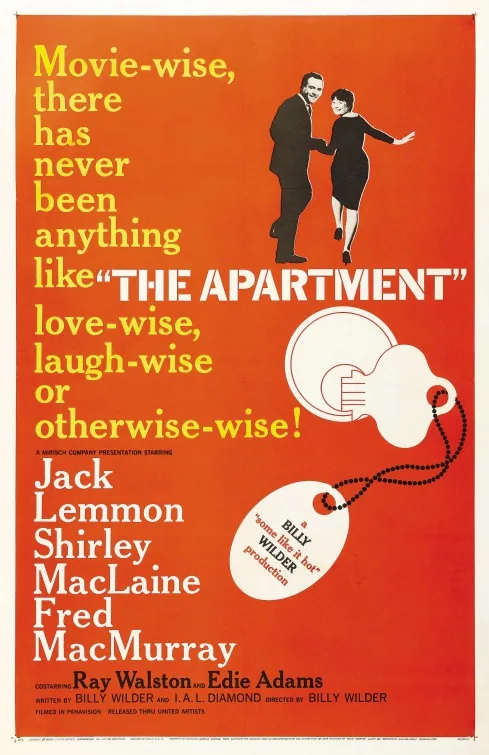
A workplace favour system turns private space into a career resource until a personal crisis exposes the moral and emotional cost of advancement.
Why this matches +
These offer a related experience with a meaningful difference in story, tone, or presentation.
An adjacent discovery: a related idea with a different viewing experience.
Genres: Drama / Romance
Shared film traits
Based on recorded story, mood and style. Your preferences can change the order.
What changes The Apartment follows vulnerable people seeking genuine connection amid exploitation and loneliness.
An insurance clerk improves his prospects by lending senior colleagues his apartment for extramarital affairs, leaving himself increasingly displaced from his own home. A promotion binds him more closely to an executive whose mistress is the elevator operator he quietly admires. When the arrangement's emotional harm becomes impossible to ignore, career compliance and romantic hope depend on whether he will continue making himself useful to people exploiting his discretion.
A friendship's changed practical arrangements expose a precarious creative career, turning repeated moves into a test of whether adaptation can occur without interpreting every change as abandonment.
Why this matches +
These offer a related experience with a meaningful difference in story, tone, or presentation.
An adjacent discovery: a related idea with a different viewing experience.
Genres: Drama / Comedy
Shared film traits
Based on recorded story, mood and style. Your preferences can change the order.
What changes Frances Ha follows a woman facing professional and personal disappointment while retaining a hopeful spirit.
A dancer in New York assumes that the life she shares with her closest friend can continue while each moves toward a creative future. Changes in housing, money and the friend's relationship expose how much stability that imagined partnership has supplied. Drifting through temporary rooms and impractical gestures, Frances must distinguish preserving an attachment from requiring it to keep confirming an identity her working life no longer supports in the same way.
Roman sex worker Cabiria survives a riverbank robbery by her lover Giorgio, then returns to her small home and tries to rebuild her faith in happiness. A chance night with a film star and a later pilgrimage briefly offer forms of recognition and hope, but a magician’s public hypnosis exposes how deeply she longs for marriage. When Oscar courts her and promises a future, Cabiria sells her home and trusts him with her savings. His betrayal leaves her walking alone through Rome, where a group of young revelers draws a tentative smile from her.
What drives the story
A chain of encounters repeatedly lets Cabiria imagine a new life, then tests whether optimism can survive exploitation without becoming foolishness.
The people at its centre
Cabiria’s exuberance and defensive pride coexist; the people around her may offer tenderness, spectacle or money, but rarely the stable care she hopes to find.
What it feels like
Fellini’s episodic street-level portrait moves between comic performance, religious ritual and sudden humiliation, with Giulietta Masina’s expressive face carrying shifts the dialogue cannot settle.
Worth knowing
Its tragicomic resilience is closer to a character portrait than a conventional romantic melodrama; hope survives here without a neat rescue or secure partner.