Based on recorded story, mood and style. Your preferences can change the order.
Coming of age
What changes Pay It Forward: episodic, steady and escalating. Moonlight: measured.
Across childhood, adolescence and adulthood, a quiet boy from Miami learns different ways to protect himself from bullying, instability at home and expectations of masculinity. A drug dealer and his partner offer care complicated by the economy harming his mother, while one friendship creates a vulnerable possibility of intimacy. The divisions between the three periods reveal how a hardened adult identity can preserve earlier wounds without extinguishing the desire to be known.
Based on recorded story, mood and style. Your preferences can change the order.
Coming of age
What changes Pay It Forward: episodic, steady and escalating. Steve: school's fragile routine is introduced, student and staff crises accumulate and future of the institution becomes urgent.
Steve is the headteacher of a last-chance reform school for boys with serious social and behavioral difficulties. Over one pivotal day, he tries to protect the school's integrity and stave off its impending closure while supporting students whose lives have been shaped by exclusion and instability. Shy, a troubled teenager, struggles with anger and his own uncertain future as staff respond to mounting crises. Set in mid-1990s England and adapted from Max Porter's novella Shy, the drama examines the fragile work of care inside an institution running short on time and resources.
Both share themes of community, plus an earnest atmosphere.
Why this matches +
Genres: Drama / Sport
Shared film traits
Based on recorded story, mood and style. Your preferences can change the order.
Coming of age
What changes Pay It Forward: episodic, steady and escalating. Radio: measured and character-led.
A high-school football coach notices a young man who spends time near the team and begins building a friendship with him. The relationship gradually brings the man into school life and the wider community, while local attitudes and the demands of the football season test the coach's commitment. Inspired by a real story, the film focuses on the dignity of everyday support and the changes that occur when a community makes room for someone it once overlooked.
Based on recorded story, mood and style. Your preferences can change the order.
What changes Pay It Forward: episodic, steady and escalating. Hulk: nonlinear and measured.
A scientist survives an accident that activates a transformation whose roots extend into his father's concealed experiments. His attempts to understand the change bring military containment and commercial interest into conflict with the recovery of childhood trauma. Anger becomes visible at a scale institutions want either to weaponize or eliminate, while the people closest to him carry histories that make protection complicated. The film gives a superhero origin the structure of a damaged family returning, treating bodily force as an expression of inherited harm rather than uncomplicated empowerment.
Based on recorded story, mood and style. Your preferences can change the order.
What changes Pay It Forward: episodic, steady and escalating. The Champ: character-led, emotional escalation, sporting climax and sentimental resolution.
Former boxing champion Billy Flynn now trains horses and tries to raise his young son T.J. on a modest Florida racetrack. T.J. admires his father and is unaware that Billy’s former wife Annie is still alive and wants to reconnect. Billy’s drinking, gambling, and pride repeatedly threaten the stability they have built, while Annie’s return forces all three to face the child’s understanding of his family. As money problems and a confrontation with a dangerous creditor push Billy back toward the ring, father and son must confront what loyalty can and cannot repair.
Based on recorded story, mood and style. Your preferences can change the order.
Coming of age
What changes Pay It Forward: episodic, steady and escalating. Precious: measured, character-driven and emotional.
In 1987 Harlem, sixteen-year-old Claireece “Precious” Jones lives under her mother Mary’s abuse and carries the consequences of sexual violence by her absent father. Her first child, a daughter with Down syndrome, is also part of the family life Precious is trying to build beyond her mother’s control. After she is expelled from school, she enters an alternative education program where teacher Blu Rain encourages her to read, write and imagine a future beyond home. Precious gives birth to a second child and learns she is HIV-positive; the support of classmates and social worker Ms. Weiss helps her name what has happened. She leaves her mother with both children and plans to continue her education.
Based on recorded story, mood and style. Your preferences can change the order.
Coming of age
Expect earnest and hopeful, with episodic and gradual trust-building pacing.
Former Marine LouAnne Johnson takes a teaching job at a California high school and finds that her students have little reason to trust another adult making promises. She experiments with lessons that connect to their immediate concerns, but the classroom's conflicts extend beyond any single teaching trick. The film follows her effort to earn attention while confronting the limits and responsibilities of entering a community from the outside.
Based on recorded story, mood and style. Your preferences can change the order.
What changes Pay It Forward: episodic, steady and escalating. Detachment: a temporary teacher’s practiced distance is challenged by students whose needs persist beyond one class..
Henry Barthes works as a substitute teacher and moves from school to school without becoming attached to colleagues or students. At an underfunded public high school, he encounters students, teachers, and administrators under strain, while his own memories of family trauma surface through narration and flashback. Tony Kaye’s drama links classroom disorder to a wider portrait of people who feel unseen, following Henry as he attempts to support a troubled student and a young woman living on the street. Its episodic form emphasizes emotional distance and brief acts of care.
Based on recorded story, mood and style. Your preferences can change the order.
Coming of age
What changes Pay It Forward: episodic, steady and escalating. Thirteen: accelerating and spiraling.
Tracy, a bright adolescent, is drawn into a fast-changing friendship with Evie, whose confidence and social standing promise entry into a more exciting world. Their closeness brings experimentation and risk, while tension at home makes it harder for Tracy’s mother to understand what is changing. The drama follows the friction between self-invention, peer influence and parental concern in an unsettled transition to adolescence.
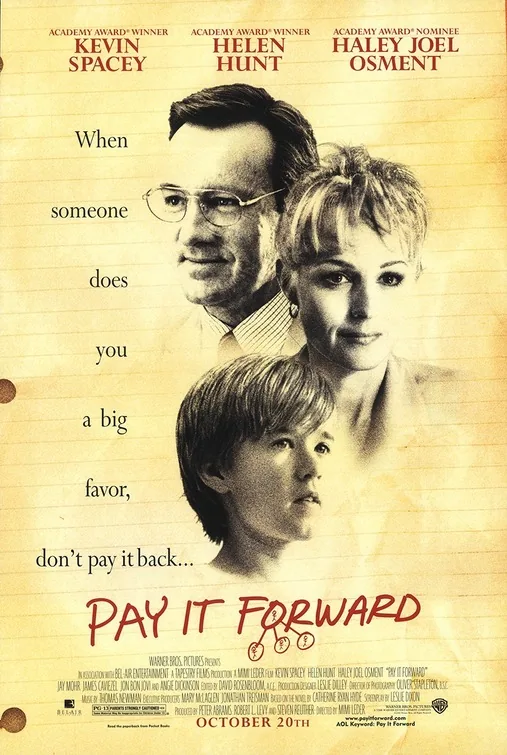
Seventh-grader Trevor McKinney takes his social-studies teacher’s challenge to devise a way to improve the world seriously: instead of repaying a favor, each recipient should help three other people. Trevor begins by sheltering Jerry, a homeless man trying to recover from addiction, and the idea connects his mother Arlene with Eugene, the teacher whose burn scars and guardedness mark a painful past. As the chain of favors grows, Trevor’s optimistic project meets relapse, disappointment and resistance. When he intervenes to protect a bullied classmate, violence interrupts the movement, but news of his plan has already spread far beyond his school.
What drives the story
Trevor’s three-person chain makes kindness a repeatable social action, but its growth does not protect the people who start it from harm.
The people at its centre
Arlene and Eugene’s attraction develops alongside their individual histories; Trevor’s idealism is active and vulnerable, not a cure for them.
What it feels like
The film is an earnest, emotionally heightened drama, moving between intimate family conflict and a news-driven account of a public movement.
Worth knowing
Its appeal lies in moral optimism under imperfect conditions, rather than in a realistic model of how social change reliably works.
KindnessIdealismAddiction
Mood
Earnest · Sentimental · Tragic
Pacing
Episodic · Steady · Escalating
Visual style
Contemporary · Naturalistic · Character-focused
Storytelling
Coming of age · Social drama · Interconnected lives