Daily needs and modest hopes shape a family's life while children discover possibilities beyond its immediate limits.
Why this matches +
These offer a related experience with a meaningful difference in story, tone, or presentation.
An adjacent discovery: a related idea with a different viewing experience.
Genres: Drama
Shared film traits
Based on recorded story, mood and style. Your preferences can change the order.
What changes A family living in poverty finds moments of tenderness and resilience while children experience the uncertainty of their surroundings.
A boy grows up in a poor rural Bengali household with an older sister whose curiosity guides his encounters with the wider world. Their mother's daily effort to keep the family together contrasts with their father's hopes for work and advancement. Small discoveries, family tensions and material insecurity unfold through changing seasons, allowing wonder and loss to emerge from the same ordinary surroundings.
Akira is pushed into an adult role without support, while the younger children depend on his decisions.
Why this matches +
These offer a related experience with a meaningful difference in story, tone, or presentation.
An adjacent discovery: a related idea with a different viewing experience.
Genres: Drama
Shared film traits
Based on recorded story, mood and style. Your preferences can change the order.
What changes Hirokazu Kore-eda observes vulnerable children improvising a family life amid neglect and poverty in Tokyo, with quiet attention to everyday routines.
A mother moves into a Tokyo apartment with her four children but hides the younger siblings from the landlord, leaving only eldest son Akira visible. When she leaves for months with little money, Akira takes responsibility for rent, food and his brothers’ and sister’s daily needs. The children have been kept out of school and away from public attention, so their shrinking resources make ordinary childhood harder to sustain. The film quietly follows the siblings’ improvised household as its fragile independence gives way to loss.
Three strangers adopt a family identity while seeking asylum and rebuilding ordinary life in France.
Why this matches +
These offer a related experience with a meaningful difference in story, tone, or presentation.
An adjacent discovery: a related idea with a different viewing experience.
Genres: Drama / Crime
Shared film traits
Based on recorded story, mood and style. Your preferences can change the order.
What changes People who initially pose as a family develop real attachments while navigating poverty, displacement and the threat of violence.
Former Tamil Tiger fighter Dheepan, a woman named Yalini, and a young girl pose as a family to seek asylum in France. Their new life begins in a housing estate where Dheepan works as a caretaker and Yalini struggles to find safety and purpose, while the family-like bond between them remains uncertain. Jacques Audiard's drama follows displacement as a daily negotiation of identity, belonging, and protection, with violence from the past intruding into the present.
The family’s separate secrets accumulate until job loss, a son’s departure and a hidden piano education force the household toward crisis.
Why this matches +
These offer a related experience with a meaningful difference in story, tone, or presentation.
An adjacent discovery: a related idea with a different viewing experience.
Genres: Drama
Shared film traits
Based on recorded story, mood and style. Your preferences can change the order.
Memory and identity
What changes Economic insecurity and secrecy unsettle a Japanese family, revealing the gap between public appearances and private care.
When office worker Ryūhei loses his position during a corporate restructuring, he conceals the dismissal from his wife and sons and keeps returning each day as if he still has a job. His teenage son Takashi announces a plan that takes him far from home, while younger Kenji secretly studies piano against his father’s wishes. Megumi, the family’s mother, is left managing a household whose members share meals but hide their fears. As their deceptions unravel, this restrained Tokyo drama follows economic insecurity into the private life of a family.
The family’s scams provide money and routine while concealing their lack of genuine care.
Why this matches +
These offer a related experience with a meaningful difference in story, tone, or presentation.
An adjacent discovery: a related idea with a different viewing experience.
Genres: Comedy / Crime
Shared film traits
Based on recorded story, mood and style. Your preferences can change the order.
Memory and identity
What changes A family survives through petty scams, but the arrival of an outsider exposes both intimacy and exploitation within the household; a more stylized American drama.
Old Dolio lives with her parents, Robert and Theresa, who have built their lives around small cons and petty theft. When they bring Melanie into a scheme, the newcomer’s warmth exposes the family’s emotional neglect and the limits of their shared routines. Miranda July’s crime comedy follows Old Dolio’s tentative movement toward connection and independence, treating affection as something unfamiliar rather than automatically available.
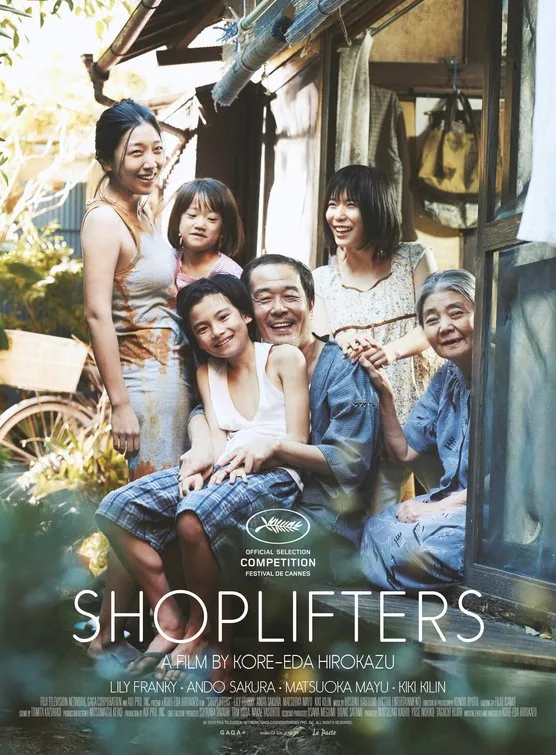
A poor Tokyo household survives through a mix of informal work and petty theft, with adults Osamu and Nobuyo caring for children who have limited security elsewhere. When the family brings a neglected young girl into their home, ordinary routines deepen into attachment and questions about who counts as family. Hirokazu Kore-eda's drama observes tenderness alongside ethical uncertainty, gradually revealing the histories and choices that hold the household together.
What drives the story
A precarious household takes in a neglected child and forms a family through care and theft.
The people at its centre
The adults offer tenderness while carrying histories that complicate their right to make decisions for the children.
What it feels like
The patient everyday scenes let affection and material hardship coexist without simple judgment.
Worth knowing
It asks whether family is defined by blood, law, or the care people actually provide.
FamilyClassCare
Mood
Tender · Melancholic · Ambiguous
Pacing
Observational · Gradually revealing
Visual style
Naturalistic interiors · Everyday gestures · Quiet Tokyo imagery