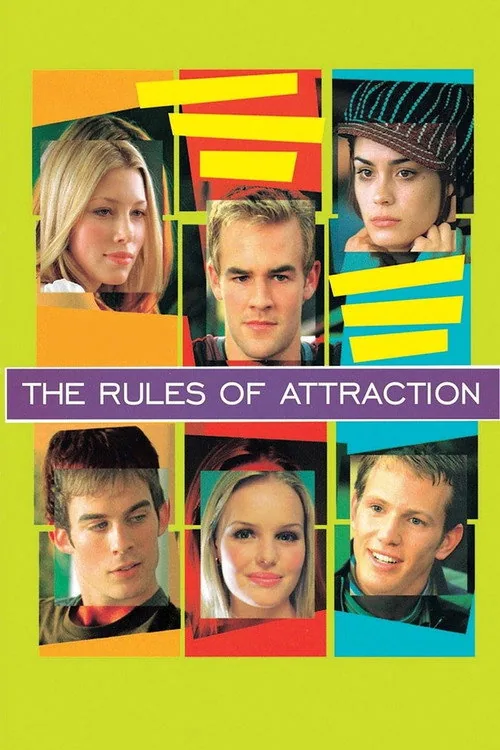
Explore films connected to The Rules of Attraction through desire and disconnection, privilege and consequence, identity and self-destruction. Choose the qualities you want to carry into your next watch.
What should feel similar?
Find your next favourite
9 films · Closest overall matches
Hide films you’ve seen or don’t want. Saved on this device.
No matches for this combination yet.
Try another option or reset your choices to see more films.
Based on recorded story, mood and style. Your preferences can change the order.
Coming of age
What changes The Rules of Attraction: interwoven character stories, nonlinear transitions and bleak convergence. Sex Drive: fast, detour-filled and ensemble comedy.
Recent graduate Ian Lafferty has built an online persona more confident than he feels, and sets out from Illinois to meet a woman in Tennessee. He borrows his older brother’s prized car and brings his friends Lance and Felicia along. Detours, mishaps, and an encounter with an Amish community complicate the road trip, while Ian’s feelings for Felicia challenge his original goal. Sean Anders’s comedy pairs adolescent bravado with friendship and self-discovery.
Based on recorded story, mood and style. Your preferences can change the order.
Coming of age · Memory and identity
What changes The Rules of Attraction: interwoven character stories, nonlinear transitions and bleak convergence. Wonder Boys: episodic and conversation-led.
At a Pittsburgh university, a blocked novelist faces a chaotic weekend involving an ambitious student, a missing manuscript and the demands of people who expect him to keep performing success. The comedy treats stalled creativity as a problem of habits and responsibility. Its loose, conversational shape lets professional embarrassment and private affection complicate one another.
Based on recorded story, mood and style. Your preferences can change the order.
Coming of age
What changes The Rules of Attraction: interwoven character stories, nonlinear transitions and bleak convergence. Love, Simon: brisk.
A closeted teenager finds an anonymous correspondent who makes disclosure feel possible before he is ready for it publicly. A classmate's discovery of the messages turns privacy into leverage, and attempts to satisfy the blackmailer damage friendships that had offered genuine support. Searching for the correspondent's identity becomes entangled with deciding when and how to speak in his own name. The romantic comedy treats coming out as a question of agency as well as recognition, while allowing the desire for safety to produce choices requiring repair.
Based on recorded story, mood and style. Your preferences can change the order.
Coming of age
What changes The Rules of Attraction: interwoven character stories, nonlinear transitions and bleak convergence. The Kissing Booth 2: senior-year setup, rival attractions and secrets, college decision pressure and school-event climax.
Elle begins senior year worried about her long-distance relationship with Noah, who is at Harvard, and her lifelong plan to attend Berkeley with best friend Lee. New classmates and a dance competition add pressure as she secretly considers another college and tries to read Noah’s friendship with Chloe. Elle also grows closer to Marco, a transfer student asked to take part in the school’s kissing booth. Vince Marcello’s sequel returns to the series’ bright teen-romance world while testing loyalty, jealousy, and the choices that accompany growing up.
Based on recorded story, mood and style. Your preferences can change the order.
Coming of age
What changes The Rules of Attraction: interwoven character stories, nonlinear transitions and bleak convergence. Everybody Wants Some!!: episodic hangouts, conversational flow and loose weekend structure.
In fall 1980, freshman pitcher Jake Bradford moves into a house shared by college baseball teammates just before classes begin. Over a few days, he meets the upperclassmen, joins their parties and games, and starts a tentative romance with theater student Beverly. The characters try on different social scenes and ideas of adulthood while enjoying the freedom before the season and academic year begin. Richard Linklater's comedy is a loose ensemble coming-of-age story, built from conversations, music, and the small rituals of a team settling into a new campus life.
Based on recorded story, mood and style. Your preferences can change the order.
Memory and identity
What changes The Rules of Attraction: interwoven character stories, nonlinear transitions and bleak convergence. Love: fragmented chronology, intimate relationship scenes and memory-driven structure.
American film student Murphy lives in Paris with his partner and young son, but a message about his former girlfriend Electra sends him into memories of their intense relationship. Told through shifts in time, Gaspar Noé’s erotic drama follows desire, jealousy, experimentation, and the emotional consequences of choices made by a young couple. The film contains explicit, unsimulated sexual material and nudity; its sexual imagery is central to its style and should be considered before viewing.
Based on recorded story, mood and style. Your preferences can change the order.
Coming of age · Memory and identity
What changes The Rules of Attraction: interwoven character stories, nonlinear transitions and bleak convergence. Ghost World: loose and observational.
After high school, Enid and Rebecca confront an uncertain adulthood in a town where their ironic distance from ordinary life is both shield and habit. When Enid befriends Seymour, an older record collector who shares her outsider instincts, the friendship complicates the girls’ plans and exposes their different needs. The comedy observes drift, taste and loneliness without turning growing up into a neat lesson.
Based on recorded story, mood and style. Your preferences can change the order.
Coming of age · Memory and identity
What changes The Rules of Attraction: interwoven character stories, nonlinear transitions and bleak convergence. 40 Days and 40 Nights: countdown structure, sexual-comedy set pieces and romantic resolution.
After a painful breakup, San Francisco web designer Matt Sullivan makes a Lenten vow to avoid all sexual activity for forty days and nights. His self-imposed challenge becomes harder when he meets Erica, while coworkers turn the vow into a wager and monitor his progress. Michael Lehmann’s romantic comedy uses the countdown to test Matt’s ideas about intimacy, control, and recovery from heartbreak. The film contains sexual material and depicts nonconsensual sexual contact as a comic plot device.
Based on recorded story, mood and style. Your preferences can change the order.
Coming of age
What changes The Rules of Attraction: interwoven character stories, nonlinear transitions and bleak convergence. The Girl Next Door: brisk and escalating.
A high-school senior’s orderly plans change when he becomes attracted to the young woman who moves in next door. He later learns that her past in adult entertainment complicates their relationship and his ambitions. The teen romantic comedy follows his attempt to separate genuine affection from peer pressure, reputation and the opportunity to pursue a more lucrative social path.
At Camden College, students Sean Bateman, Lauren Hynde, and Paul Denton move through parties, hookups, drugs, and private disappointments with little ability to communicate honestly. Lauren longs for her former boyfriend Victor, while Sean reads anonymous love letters as a sign of connection and Paul struggles with rejection. Their overlapping stories reveal a campus culture where desire is frequently unreturned and consequences are displaced onto others. The dark comedy adapts Bret Easton Ellis through fragmented chronology, shifting viewpoints, and a deliberately disaffected tone.
What drives the story
Each student's desire points toward someone who is emotionally unavailable, creating a chain of misread signals and harm.
The people at its centre
Sean, Lauren, and Paul circle one another without forming the kind of mutual connection they imagine or request.
What it feels like
An abrasive campus black comedy uses nonlinear editing and internal monologues to create social and emotional disorientation.
Worth knowing
It portrays privileged college alienation through intersecting characters, not as a conventional romance or campus-success story.
desire and disconnectionprivilege and consequenceidentity and self-destruction
Mood
cynical · disorienting · provocative
Pacing
interwoven character stories · nonlinear transitions · bleak convergence