Based on recorded story, mood and style. Your preferences can change the order.
Romance and intimacy · Social hierarchy
What changes Wicker: comic escalation, character-led and episodic. Atlantique: slow atmospheric build, interwoven perspectives and mystery revelation.
On the outskirts of Dakar, construction workers leave by sea after months without pay, including Souleiman, who is in love with Ada. Ada is promised to a wealthier man, and the crossing leaves her waiting for news as her wedding approaches. A detective investigates a mysterious fire while young women in the community suffer an unexplained illness. The story blends romance, migration, social inequality, and the supernatural presence of those lost at sea.
Based on recorded story, mood and style. Your preferences can change the order.
Romance and intimacy · Family and care
What changes Wicker: comic escalation, character-led and episodic. Hot Frosty: light, romantic and steadily sentimental.
Kathy, a widow running a small diner, is struggling with grief and the burden of keeping her life moving. A magical scarf brings a snowman to life as a charming man who experiences the world with childlike openness. Their unlikely connection encourages Kathy to reengage with friendship, community and romance while the snowman's temporary nature gives their holiday story a gentle edge of impermanence.
Based on recorded story, mood and style. Your preferences can change the order.
What changes Wicker: comic escalation, character-led and episodic. When in Rome: comic reversals around courtship.
Beth, an ambitious art curator weary of romantic disappointment, travels to Rome for her sister’s wedding and meets best man Nick. After a playful encounter with coins from a fountain, several men pursue her under the belief that she has enchanted them, while she tries to determine which feelings are genuine. The romantic fantasy comedy mixes mistaken attraction with Beth’s own uncertainty about whether love fits her carefully ordered life.
Based on recorded story, mood and style. Your preferences can change the order.
What changes Wicker: comic escalation, character-led and episodic. The Princess Bride: quest-driven and episodic.
In a frame story, a grandfather reads a tale of true love and high adventure to his reluctant grandson. In the story, farmhand Westley and Buttercup fall in love before Westley leaves to seek his fortune and is believed killed by the Dread Pirate Roberts. Buttercup is then forced to marry Prince Humperdinck and is kidnapped by a trio of hired misfits, including Inigo Montoya, who seeks the man who killed his father. A masked pursuer catches up with them, and the shifting alliances open a path toward the castle. The film moves between romance, swordplay, revenge and comic interruption, while the reader's reactions keep reminding us that the story knows it is being told. Its sincerity is part of the joke, not cancelled by it.
Based on recorded story, mood and style. Your preferences can change the order.
What changes Wicker: comic escalation, character-led and episodic. Beauty and the Beast: measured.
A young woman from a provincial village exchanges her freedom for her father's release from an enchanted castle. Living among transformed servants exposes the isolation and volatile habits of their ruler, whose apparent monstrosity does not explain every act of cruelty around her. A rejected admirer outside the castle turns popular approval into a weapon, while tentative trust inside requires more than the hope that appearance can change.
Based on recorded story, mood and style. Your preferences can change the order.
What changes Wicker: comic escalation, character-led and episodic. Into the Woods: episodic and escalating.
A baker and his wife enter a forest to assemble objects that could lift a curse preventing them from having a child. Their bargain intersects with other familiar wishes, allowing each apparent success to help produce another person's trouble. When the initial happy endings fail to remain stable, surviving characters must act without the moral simplicity the stories seemed to promise. The musical makes desire causally entangled, shifting from acquisition toward responsibility for damage that cannot be assigned to one conveniently isolated villain.
Based on recorded story, mood and style. Your preferences can change the order.
What changes Wicker: comic escalation, character-led and episodic. Starman: road-movie progression, romantic trust develops and emotional rendezvous deadline.
After a peaceful alien probe is shot down, its lone visitor finds the home of Jenny Hayden, a widow still grieving her husband. The being uses a lock of Scott's hair to create a human body and asks Jenny to help him travel across the country to reach a rendezvous point. Pursued by government agents, the unlikely pair share a road journey that changes Jenny's understanding of loss and the visitor's understanding of humanity. John Carpenter's science-fiction romance combines pursuit with a gentle first-contact story.
Based on recorded story, mood and style. Your preferences can change the order.
What changes Wicker: comic escalation, character-led and episodic. Just like Heaven: measured and gentle.
An architect rents a San Francisco apartment and discovers that a woman’s presence seems to remain there, though she cannot explain how she arrived. Their early conflict gives way to a search for answers and a relationship built under unusual circumstances. The romantic fantasy balances grief, memory and domestic comedy as the pair confront what can and cannot be changed.
Based on recorded story, mood and style. Your preferences can change the order.
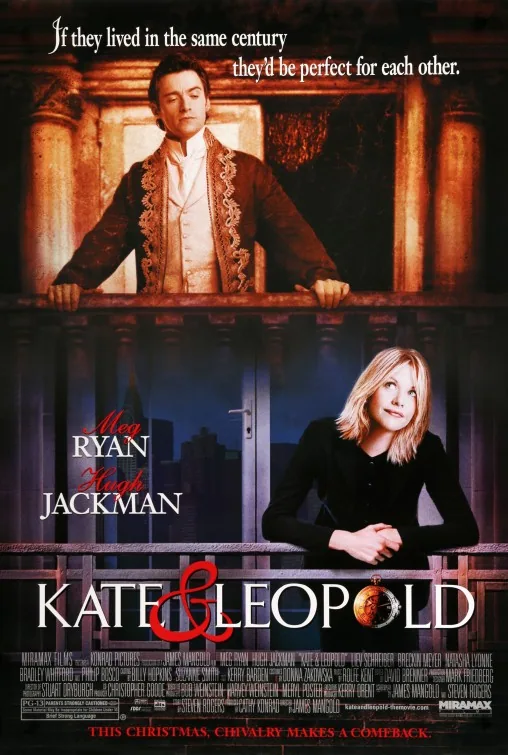
What changes Wicker: comic escalation, character-led and episodic. Kate & Leopold: measured and romantic build.
A 19th-century duke is displaced into present-day New York, where he meets Kate, a career-minded woman skeptical of romance. Their attraction puts social manners, ambition and the possibility of belonging in tension across two eras. The time-travel comedy builds its central question around whether a person can adapt to a different historical world without losing the values that define him.
On the edge of a seaside village, a solitary fisherwoman is mocked for her smell, independence, and opinions. Tired of her neighbors’ treatment, she commissions an artisan to make her a husband from wicker. The unusual romance unsettles the town’s conventions and provokes jealousy and chaos. Alex Huston Fischer and Eleanor Wilson shape the fable as a comic fantasy about intimacy, social belonging, and the costs of respectability.
What drives the story
The fisherwoman commissions a wicker husband after her neighbors' ridicule makes her isolation impossible to ignore.
The people at its centre
Her new companion disrupts the village's expectations and draws out jealousy among its residents.
What it feels like
The handmade husband makes questions of intimacy and social convention literal within the fable.
Worth knowing
Its comic oddity supports a sincere romance while keeping the village's unease in view.