A teacher's attempt to resolve thefts through evidence sets off a widening conflict over who controls the inquiry.
Why this matches +
Selected for the central appeal: Institutional dramas about possible abuse, uncertain evidence and the costs of moral certainty.
Genres: Drama
Shared film traits
Based on recorded story, mood and style. Your preferences can change the order.
What changes The Teachers' Lounge follows a school investigation where partial evidence and certainty create escalating conflict.
New teacher Carla Nowak tries to handle classroom thefts fairly while her colleagues and students press her to identify a suspect. A discreet recording implicates a staff member and widens the dispute. The inquiry spreads through the school, straining trust between Carla, her class, parents and administrators as competing ideas of fairness turn into public accusation.
A newcomer and a visitor disrupt the house’s routine, forcing its residents and the Church to respond to buried accusations.
Why this matches +
Selected for the central appeal: Institutional dramas about possible abuse, uncertain evidence and the costs of moral certainty.
Genres: Drama
Shared film traits
Based on recorded story, mood and style. Your preferences can change the order.
What changes The Club examines allegations of abuse and institutional protection within a religious community.
Four retired Catholic priests live under the supervision of a caretaker in a secluded house beside a small Chilean coastal town. Their quiet routine is disturbed when a new priest arrives and a former victim appears outside, demanding that the men face their past. Church officials send a visitor to assess the crisis, and the residents’ history of secrecy and institutional protection begins to surface. Pablo Larraín’s drama observes how the house functions as both refuge and confinement.
A local allegation expands into an investigation of systematic concealment, requiring documentary proof of institutional knowledge rather than another isolated accusation.
Why this matches +
These offer a related experience with a meaningful difference in story, tone, or presentation.
An adjacent discovery: a related idea with a different viewing experience.
Genres: Drama / Biography
Shared film traits
Based on recorded story, mood and style. Your preferences can change the order.
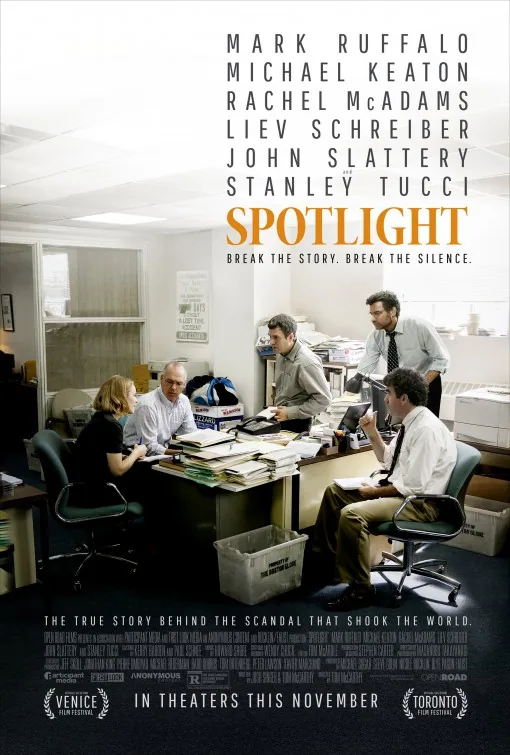
What changes Spotlight follows reporters investigating abuse and the institutional structures that concealed it.
A newspaper's investigative team begins examining allegations against a Boston priest and encounters a pattern extending far beyond an individual offence. Reporters work through court records, reluctant witnesses and professional networks while institutional resistance repeatedly narrows what can be made public. The inquiry also forces them to confront how their own organisation previously missed opportunities to act, making publication a test of collective responsibility as well as evidentiary persistence.
A papal election becomes an investigation as new evidence reorders the candidates and forces Lawrence to weigh institutional stability against conscience.
Why this matches +
These offer a related experience with a meaningful difference in story, tone, or presentation.
An adjacent discovery: a related idea with a different viewing experience.
Genres: Drama / Thriller
Shared film traits
Based on recorded story, mood and style. Your preferences can change the order.
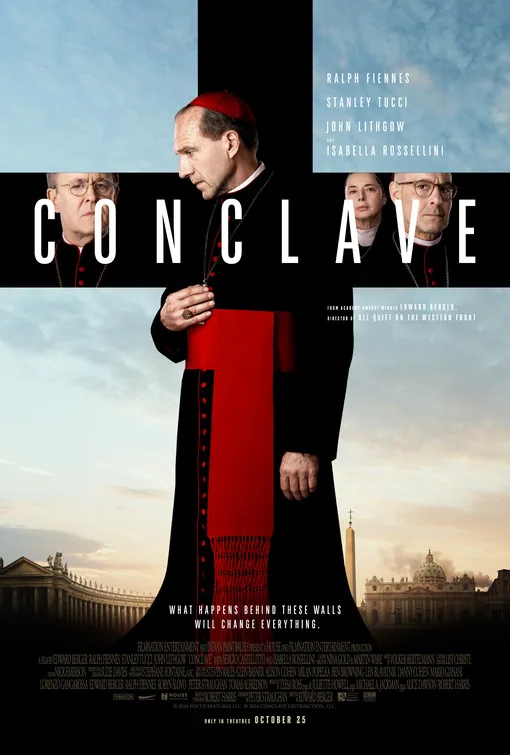
What changes Conclave follows a religious institution navigating rumor, evidence and competing claims to moral authority.
After a pope dies, Cardinal Lawrence leads the secluded conclave that must choose a successor while rival clerics negotiate alliances and a series of disclosures alters the field. The closed setting turns procedure, rumor and moral compromise into a political thriller. A final revelation about Cardinal Benitez's intersex embodiment changes how characters and viewers interpret the election, but it must not be framed as proof of deception or as a claim about intersex people generally. The film is speculative fiction, not an authoritative guide to church law or actual conclaves. Lawrence's search for the source of each revelation unfolds inside the election's strict seclusion.
A child’s confused statement triggers suspicion, but the community’s reaction quickly becomes a second punishment Lucas cannot escape through ordinary explanation. The film aligns viewers with his innocence while preserving an unsettling residue of uncertainty at the end.
Why this matches +
These offer a related experience with a meaningful difference in story, tone, or presentation.
An adjacent discovery: a related idea with a different viewing experience.
Genres: Drama
Shared film traits
Based on recorded story, mood and style. Your preferences can change the order.
What changes The Hunt examines the damage caused when a community acts on an allegation amid uncertainty.
Lucas, a divorced kindergarten teacher trying to rebuild his relationship with his teenage son, becomes the focus of suspicion after a young pupil’s confused statement is interpreted as abuse. As the allegation spreads through a close-knit Danish community, Lucas loses his job, friends and ordinary access to public life despite his denials. The film stays close to his experience of social rejection and the community’s fear, showing how uncertainty hardens when people repeat it. It strongly positions viewers to see the accusation as mistaken, but its single fictional case is not a general account of abuse investigations or children’s testimony. The unresolved final beat keeps social suspicion alive after the community appears ready to move on.
At a Bronx Catholic school in 1964, a principal becomes convinced that a priest's relationship with a vulnerable student conceals misconduct. A younger teacher's observations provide troubling signs without a settled explanation, while the boy's mother faces dangers that do not fit the principal's preferred moral choices. Institutional rank and the fear of failing a child turn a dispute over evidence into an encounter with the cost of certainty, without supplying a definitive account of what occurred.
What drives the story
Suspicion leads a school leader to confront a more institutionally protected colleague, making the demand to act before proof collides with the risk of mistaking conviction for knowledge. A limited set of observations is interpreted by people with unequal authority and incompatible ideas of protection.
The people at its centre
Aloysius's forceful responsibility contrasts with James's uncertainty, while Mrs. Miller's constrained options prevent protecting her son from becoming a simple choice among safe alternatives. Mrs. Miller weighs her son’s safety against the consequences of losing his access to the school and priest.
What it feels like
Concentrated performances and verbal confrontations sustain a chamber drama in which small observations accumulate pressure without becoming an unambiguous detective solution. The confined school and sharply staged conversations give silences and pauses the force of competing testimony.
Worth knowing
Match on safeguarding under unequal authority and unresolved evidence, rather than asserting either guilt or innocence or treating the mother's compromised position as indifference to her child. Neither Flynn’s institutional status nor Aloysius’s eventual doubt proves guilt or innocence for the audience.