The road performances provide the story’s structure, but Gelsomina’s dependence on Zampanò limits her alternatives. The Fool’s claim that every object has a purpose offers meaning, not a practical escape from abuse.
Why this matches +
These offer a related experience with a meaningful difference in story, tone, or presentation.
An adjacent discovery: a related idea with a different viewing experience.
Genres: Drama
Shared film traits
Based on recorded story, mood and style. Your preferences can change the order.
What changes La Strada follows a vulnerable woman subjected to cruelty and dependence in postwar Italy.
Poor Gelsomina is sold by her mother to Zampanò, a traveling strongman who takes her on the road as his assistant. His cruelty and her isolation become more visible when the Fool offers her a different account of what her companionship might mean. Gelsomina remains attached to the idea that she has a purpose, but the film does not grant her equal power to choose the life she is enduring. Zampanò abandons her after rejecting that bond, and only later recognizes the loss. Fellini’s fable uses circus performance and spiritual language to make tenderness feel possible, while its ending risks framing a woman’s suffering as a service that transforms an abusive man. Grief is not retroactive consent, redemption or proof that she had to stay.
The narrators reconstruct the sisters’ lives from partial observations, while the family’s tragedy remains beyond their complete understanding.
Why this matches +
These offer a related experience with a meaningful difference in story, tone, or presentation.
An adjacent discovery: a related idea with a different viewing experience.
Genres: Drama / Romance
Shared film traits
Based on recorded story, mood and style. Your preferences can change the order.
Coming of age · Memory and identity
What changes The Virgin Suicides filters the lives of vulnerable girls through outsiders' romanticized memories and limited understanding.
Years after five sisters died by suicide, the neighborhood boys who watched them as teenagers revisit their fragmentary memories of the Lisbon family. The film centers on the girls’ restricted lives under protective parents and on the distance between what the boys observed and what they can truly know. Sofia Coppola’s adaptation is a melancholy study of adolescence, family control, and retrospective mythmaking; its subject matter is handled as tragedy, not as a puzzle to solve.
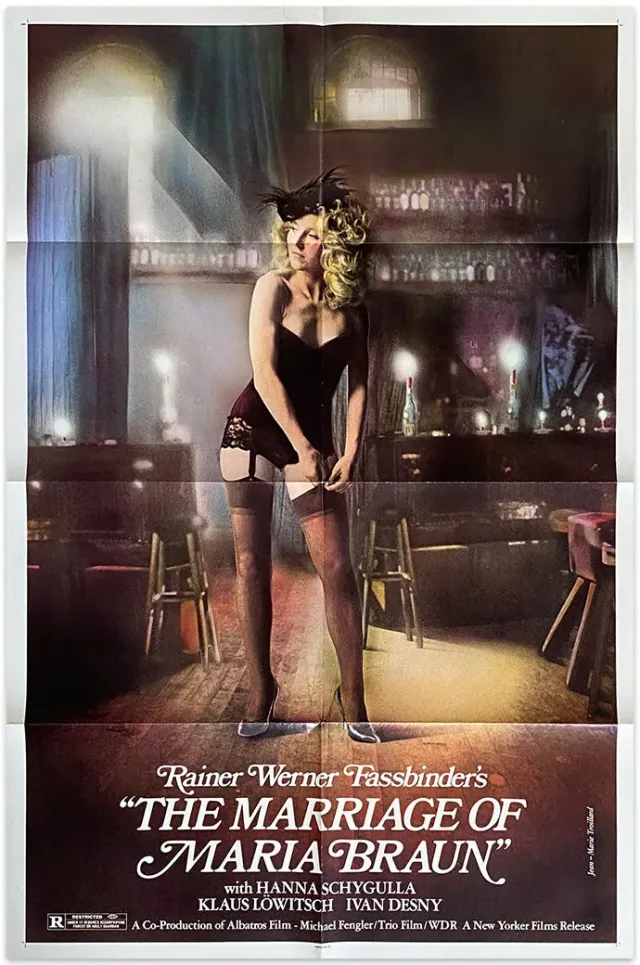
Maria’s efforts to survive become increasingly entangled with the economic recovery around her, so success carries both agency and moral cost.
Why this matches +
These offer a related experience with a meaningful difference in story, tone, or presentation.
An adjacent discovery: a related idea with a different viewing experience.
Genres: Drama / Art
Shared film traits
Based on recorded story, mood and style. Your preferences can change the order.
What changes The Marriage of Maria Braun follows a woman negotiating survival and social judgment in wartime and postwar Germany.
Maria Berger marries Hermann Braun during a wartime air raid, then loses him to the front and the uncertainty of Germany’s defeat. Believing him dead, she finds work in the unstable postwar economy and uses her intelligence and charm to secure a future for herself and her family. A relationship with American soldier Bill brings affection as well as practical support, while Maria continues to hold onto the idea of Hermann. As she rises from precarious survival into financial success, the film links her private compromises to a country rebuilding itself and postponing its reckoning with the past.
Mia’s desire for independence and dance is complicated by family routines and an adult whose intentions she misreads.
Why this matches +
These offer a related experience with a meaningful difference in story, tone, or presentation.
An adjacent discovery: a related idea with a different viewing experience.
Genres: Drama
Shared film traits
Based on recorded story, mood and style. Your preferences can change the order.
Coming of age
What changes Fish Tank observes a young woman's vulnerability and constrained choices within an unsupportive community.
Fifteen-year-old Mia lives with her mother and younger sister in an Essex housing estate, feeling restless and isolated from the people around her. Dance is one of the few things that gives her a sense of direction. When her mother’s new boyfriend enters the household, Mia becomes drawn into a complicated relationship that changes her understanding of trust and adulthood. Andrea Arnold’s British drama follows her through a compressed period of family tension and self-discovery, using close observation and a young protagonist’s perspective to depict a life with few easy choices.
The vote gives each woman a formal voice in a crisis shaped by coercion.
Why this matches +
These offer a related experience with a meaningful difference in story, tone, or presentation.
An adjacent discovery: a related idea with a different viewing experience.
Genres: Drama
Shared film traits
Based on recorded story, mood and style. Your preferences can change the order.
What changes Women Talking examines women confronting communal abuse and deciding how to respond together.
Women in an isolated Mennonite colony gather after discovering that men have drugged and sexually assaulted them. With the perpetrators absent, they debate whether to stay, fight, or leave, weighing faith, safety, family, and the future of their children. The drama centers collective deliberation rather than depicting violence as spectacle, asking how a community can make a decision when its inherited rules have failed to protect it.
In wartime Sicily, adolescent Renato watches Malèna, a young woman whose beauty makes her the subject of the town’s desire, gossip and punishment. He imagines a relationship with her but has little knowledge of her thoughts or access to the choices shaping her life. When her husband is reported dead and the war deepens, social protection falls away; the town first objectifies Malèna and then condemns her for the very attention it has imposed. Giuseppe Tornatore’s nostalgic narration and explicit scenes of cruelty place viewers inside Renato’s gaze while also exposing its limits. His late gesture is small beside the material vulnerability and communal violence she has endured. The film is not an equal romance or a simple fond memory of boyhood.
What drives the story
Renato’s observation frames the story, but Malèna’s changing treatment is driven by wartime loss, economic precarity and collective rumor. The town helps create the conditions it later uses to condemn her.
The people at its centre
Renato’s imagined intimacy differs from Malèna’s attachment to her husband and her need for security. He can fantasize freely where she faces consequences, so his point of view should not be mistaken for access to hers.
What it feels like
Lyrical voiceover and sunlit recollection collide with explicit public humiliation and violence. That contrast can make the film’s nostalgia uncomfortable, because the narrator’s aesthetic memory risks softening the harm it records.
Worth knowing
Discuss the movie’s objectifying gaze alongside its critique of communal misogyny. Malèna’s endurance is not a romantic lesson, and Renato’s late intervention does not undo the complicity built into his earlier spectatorship.
MisogynyLookingCollective cruelty
Mood
Lyrical · Disturbing · Melancholy
Pacing
Episodic · Measured
Visual style
Adolescent fantasy · Wartime town imagery · Explicit communal violence