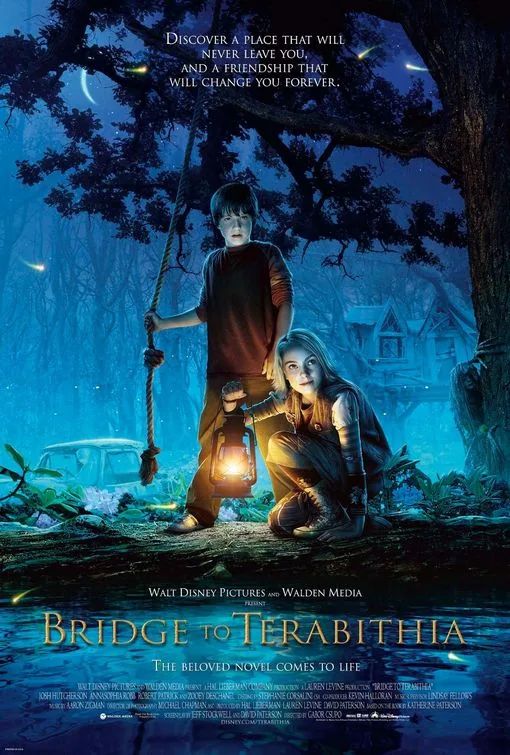
An imaginative friendship creates a shared refuge that gradually changes how a withdrawn child responds to other people and real loss.
Why this matches +
Selected for the central appeal: Stories about creativity, childhood imagination and family bonds shaped by illness or grief.
Genres: Drama / Adventure
Shared film traits
Based on recorded story, mood and style. Your preferences can change the order.
What changes Bridge to Terabithia follows children whose shared imaginary world helps them confront painful loss.
A solitary boy frustrated by family pressures and school humiliation befriends a new girl whose imagination changes how he sees their surroundings. Together they create a private fantasy kingdom that gives ordinary difficulties an alternate form and makes trust feel possible. Their friendship's consequences eventually require him to bring imaginative courage back into a world where care, grief and responsibility cannot remain protected by invented rules.
Travers’s contractual objections are not merely artistic fussiness: the proposed adaptation touches memories she has converted into fiction and has spent decades guarding.
Why this matches +
Selected for the central appeal: Stories about creativity, childhood imagination and family bonds shaped by illness or grief.
Genres: Drama / Biography
Shared film traits
Based on recorded story, mood and style. Your preferences can change the order.
Music and performance
What changes Saving Mr. Banks dramatizes a beloved children's story reaching the stage or screen while exploring its author's emotional history.
In the early 1960s, financially pressured author P. L. Travers travels to Los Angeles to negotiate Walt Disney’s long pursuit of the Mary Poppins screen rights. She resists the changes proposed by the studio and its songwriters, while memories of her childhood in Australia reveal the complicated love she had for her imaginative but alcoholic father and the aunt whose strict presence helped shape the nanny. The present-day dispute over tone, animation and approval gradually becomes intertwined with Travers’s effort to revisit her father’s failures. The film ends with her response to the finished movie, though its version of the negotiation is a dramatized account.
A child’s death alters Agnes and William’s marriage, while their separate responses to grief lead toward an imagined relation between family loss and theatrical creation. The film imagines grief across a marriage without access to the historical couple’s private interior lives.
Why this matches +
These offer a related experience with a meaningful difference in story, tone, or presentation.
An adjacent discovery: a related idea with a different viewing experience.
Genres: Drama / History
Shared film traits
Based on recorded story, mood and style. Your preferences can change the order.
Music and performance
What changes Hamnet links a playwright's creative life with family grief and the loss of a child.
Chloé Zhao’s adaptation imagines the marriage of Agnes and William Shakespeare around the death of their young son Hamnet and the grief that follows. Agnes’s perspective keeps domestic care, intuitive knowledge and loss in the foreground, while the later theatre sequence proposes a powerful artistic response to bereavement. The connection between this private tragedy and Hamlet is the film’s imaginative premise, not a documented explanation of Shakespeare’s writing. Its intimate attention to family life builds toward an emotionally expansive performance, asking how art can give grief form without claiming to recover the historical couple’s private thoughts.
A blocked production gains momentum through a concealed performer and forbidden romance, while theatre deadlines collide with marriage and social rules.
Why this matches +
These offer a related experience with a meaningful difference in story, tone, or presentation.
An adjacent discovery: a related idea with a different viewing experience.
Genres: Drama / Romance
Shared film traits
Based on recorded story, mood and style. Your preferences can change the order.
Music and performance
What changes Shakespeare in Love imagines a playwright's personal relationships inspiring a famous work.
A young playwright struggling to complete a promised production finds inspiration in a merchant's daughter who longs to act despite women being excluded from the stage. Disguised as a male performer, she joins his company, and their affair begins to reshape the work being rehearsed. Financial pressures, theatrical rivalries and her arranged marriage make the performance a temporary space in which desire can flourish without controlling the world outside.
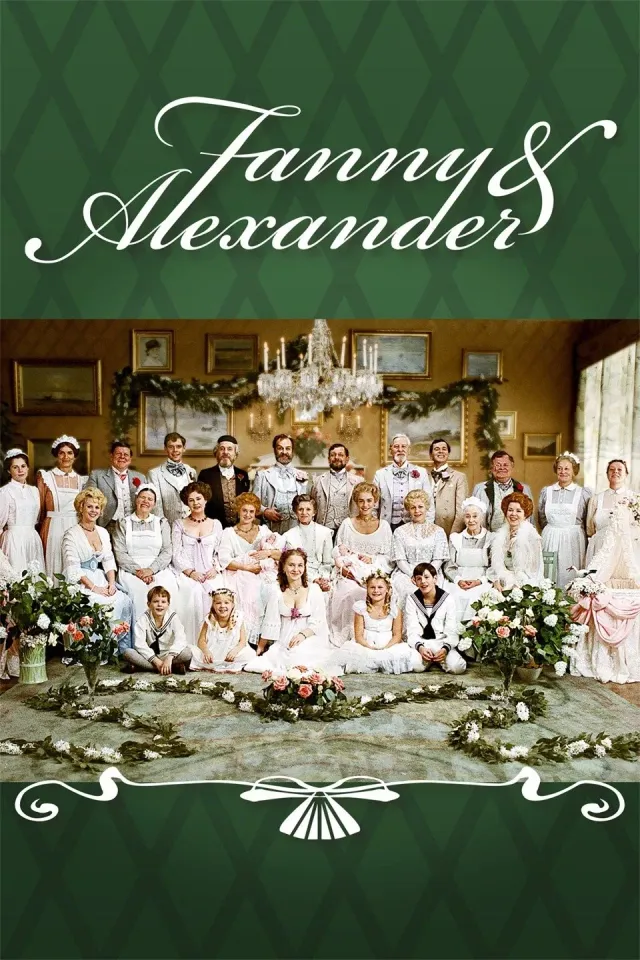
Bereavement transfers the children into an authoritarian household, where legal and familial vulnerability makes rescue a collective act rather than a simple triumph of imagination. The father’s death changes household authority, making legal dependency part of the children’s danger.
Why this matches +
These offer a related experience with a meaningful difference in story, tone, or presentation.
An adjacent discovery: a related idea with a different viewing experience.
Genres: Drama
Shared film traits
Based on recorded story, mood and style. Your preferences can change the order.
What changes Fanny and Alexander uses a child's imaginative perspective to explore theater, family and grief.
After their father dies, Fanny and Alexander move from the Ekdahl family’s theatrical, affectionate and imperfect home into the bishop’s rigid household. Alexander’s vivid imagination contests an authority that treats obedience as proof of virtue, while their mother’s marriage and the children’s vulnerability limit the protection she can provide. Their escape depends on an extended family whose earlier warmth should not be mistaken for innocence. Because Bergman released both a shorter theatrical version and a much longer television version, the balance between family life, punishment and uncanny perception changes with the cut being watched.
After a disappointing play, J. M. Barrie forms a friendship with Sylvia Llewelyn Davies and her sons, finding in shared imaginative games a way to engage with childhood and grief. The bond inspires Peter Pan but also exposes tensions with his wife and with the family’s different needs. As Sylvia’s illness narrows the future, a performance brought into the home becomes an act of accompaniment rather than simply a triumph for the playwright. The film compresses and sentimentalizes biographical material, so its emotional account of inspiration should not be mistaken for a complete record of the real family or Barrie’s obligations to them.
What drives the story
A writer’s contact with a bereaved household develops into a play whose first performance for the family offers companionship rather than only a career breakthrough. The play’s domestic performance matters because it brings imagination to the family rather than only to an audience.
The people at its centre
Barrie’s attention supports the boys, while Sylvia and Barrie’s wife occupy separate positions in a story that risks centering his creative self-understanding. Barrie’s creative awakening is not the same as fulfilling Sylvia’s or her sons’ needs.
What it feels like
Domestic period scenes open into visualized play and theatrical fantasy, balancing warm invention with a progressively direct awareness of illness and loss. Fantasy gradually shares screen space with illness, shifting warmth toward anticipatory grief.
Worth knowing
Compare with art emerging from shared care and preparation for loss, while treating this as selective biography rather than an exhaustive account of Barrie, Sylvia or her sons. The film’s compression is part of its emotional method and a limit on its biographical authority.
ImaginationGriefArt
Mood
Warm · Tender · Melancholic
Pacing
Measured
Visual style
Period detail · Visualized fantasy · Theatrical
Storytelling
Writer's stalled work · Shared play becomes performance · Illness accompaniment