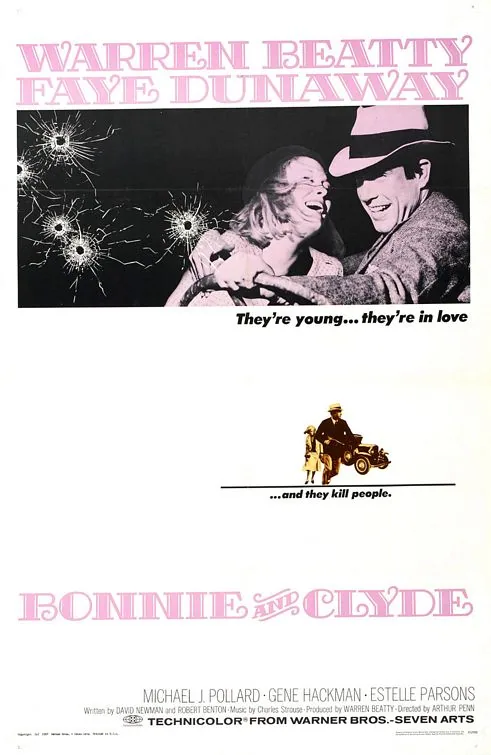
An intimate escape through robbery becomes a public criminal persona whose growing visibility makes continued movement more necessary and less protective.
Why this matches +
These offer a related experience with a meaningful difference in story, tone, or presentation.
An adjacent discovery: a related idea with a different viewing experience.
Genres: Crime / Drama
Shared film traits
Based on recorded story, mood and style. Your preferences can change the order.
What changes Bonnie and Clyde follows a couple whose intense relationship becomes entangled with a violent criminal spree.
A bored young woman joins a small-time criminal whose confidence offers an escape from ordinary work and domestic expectation. Their robberies create a public image that grows faster than their ability to manage danger, while companions and relatives complicate the intimate partnership. Movement across the Depression-era landscape turns apparent freedom into a narrowing flight, making notoriety both a source of identity and an obstacle to surviving outside it.
The pact shapes a relationship that provides mutual presence without a promise of recovery. Ben’s worsening health keeps the agreement under pressure, while Sera must decide what care can mean when he rejects intervention.
Why this matches +
These offer a related experience with a meaningful difference in story, tone, or presentation.
An adjacent discovery: a related idea with a different viewing experience.
Genres: Drama / Romance
Shared film traits
Based on recorded story, mood and style. Your preferences can change the order.
What changes Leaving Las Vegas portrays a relationship between deeply vulnerable outsiders amid self-destructive behavior.
After losing his job and family, screenwriter Ben Sanderson arrives in Las Vegas intending to drink himself to death. He meets sex worker Sera, and they form a relationship around an explicit pact: she will not ask him to stop drinking, and he will not interfere with her work. Their agreement offers companionship while refusing the usual rescue plot, but it also leaves each person exposed to the limits of what the other can provide. Sera has desires, work and boundaries beyond Ben’s decline; her care does not mean she endorses his death. The film’s ending refuses a recovery arc, yet that artistic choice is not evidence that treatment or support cannot help people with addiction. Its bleak romance should remain a portrait of two characters, not advice about care.
A beginner's rapid adaptation to a market's incentives escalates from opportunistic documentation towards manufacturing the conditions of valuable footage.
Why this matches +
These offer a related experience with a meaningful difference in story, tone, or presentation.
An adjacent discovery: a related idea with a different viewing experience.
Genres: Crime / Thriller
Shared film traits
Based on recorded story, mood and style. Your preferences can change the order.
What changes Nightcrawler follows a marginalized outsider whose pursuit of survival and recognition leads to moral exploitation.
An unemployed outsider discovers that graphic footage of crime and disaster can be sold to local television news. Learning what a producer rewards, he turns observation into increasingly active manipulation of scenes and people. Professional self-improvement language conceals a predatory account of success, while the relationship between an ambitious freelancer and an institution hungry for sensational material makes exploitation look like efficient business practice.
Conditional hospitality becomes a labor bargain whose terms worsen whenever the fugitive's outside options narrow, making the town's claimed generosity a structure of coercion. After a search notice raises the town’s perceived risk, residents increase their demands while Grace’s alternatives shrink.
Why this matches +
These offer a related experience with a meaningful difference in story, tone, or presentation.
An adjacent discovery: a related idea with a different viewing experience.
Genres: Drama / Crime
Shared film traits
Based on recorded story, mood and style. Your preferences can change the order.
What changes Dogville examines the exploitation and vulnerability of a woman with few resources or safe choices.
A woman fleeing gangsters accepts shelter in an isolated town, where an aspiring moral leader proposes her presence as a test of communal generosity. Work initially offered as gratitude becomes the condition of being allowed to remain, and her increasing vulnerability gives neighbors leverage to demand more. When the protection they claim to provide becomes systematic exploitation, a later reversal of power questions both the community's self-description and the moral certainty of punishing it. Its exposed stage makes spectators watch private coercion as collective behavior, not as unseen domestic misfortune.
The pursuit is also a feedback loop: killings generate media attention, and coverage strengthens the celebrity myth that keeps the spree in public view.
Why this matches +
These offer a related experience with a meaningful difference in story, tone, or presentation.
An adjacent discovery: a related idea with a different viewing experience.
Genres: Crime / Drama
Shared film traits
Based on recorded story, mood and style. Your preferences can change the order.
What changes Natural Born Killers follows a violent couple whose bond and crimes become the subject of public attention.
Mickey and Mallory Knox begin a cross-state murder spree after fleeing abusive family histories and bonding through violence. Detective Jack Scagnetti pursues them while concealing his own violent past, and television host Wayne Gale turns the couple into a sensational media phenomenon. After a brief encounter with a Navajo man who shelters them, their capture leads to prison and a televised interview that becomes another volatile confrontation. The film's shifting visual styles and media parody ask how criminal violence is packaged as entertainment even as the central couple remain responsible for their brutality.
On the verge of suicide, Aileen Wuornos meets Selby Wall and falls into an intense relationship with her. After a client rapes and attacks Aileen, she kills him and decides to leave sex work, but poverty and repeated job rejections push her back into prostitution. She kills more clients, claiming self-defense, while Selby becomes increasingly uncertain about what she knows. Aileen's stolen-car trail, police investigation and eventual arrest unravel the life the pair tried to build. The film follows her trial and execution while presenting a dramatized, intimate account rather than a documentary record of Wuornos's life.
What drives the story
The plot turns on an unstable boundary between a first act of survival and later murders Aileen rationalizes, then tracks how secrecy corrodes the couple's shared escape.
The people at its centre
Aileen's devotion to Selby is both sincere and controlling; Selby's dependence, fear and eventual cooperation make the romance inseparable from danger.
What it feels like
A restrained crime drama stays close to Aileen's perspective, using intimacy and bleak setting to make escalating violence disturbing rather than thrilling.
Worth knowing
Selby Wall is a fictionalized character based on Tyria Moore, and the film compresses events and motives. It presents Aileen's first killing as self-defense and later killings through a dramatized perspective; that framing cannot establish what happened in each real case. Its intimate, bleak focus on precarity distinguishes it from a celebratory serial-killer thriller.