The women’s forced admission reflects the power families and church authorities hold over young women’s lives.
Why this matches +
Related viewing experiences with the specific differences recorded for each pair.
An adjacent discovery: a related idea with a different viewing experience.
Genres: Drama / Historical
Shared film traits
Based on recorded story, mood and style. Your preferences can change the order.
What changes Religious discipline normalizes humiliation and abuse of vulnerable young people; an explicitly coercive institution and survivor escape replace a dispersed village mystery.
In 1960s Ireland, Margaret, Bernadette, Rose and Crispina are sent by family or caretakers to a Magdalene laundry, where religious authorities claim to reform women considered sinful. Their work is exhausting, their freedom is restricted and the women face humiliation and abuse from the institution’s leadership. The film follows their attempts to endure the daily regime and preserve relationships with one another, while the asylum’s religious language masks a system that benefits from their labor and keeps them isolated from the outside world.
The repeated passage through familiar school spaces gradually changes how earlier ordinary moments feel.
Why this matches +
Related viewing experiences with the specific differences recorded for each pair.
An adjacent discovery: a related idea with a different viewing experience.
Genres: Drama / Thriller
Shared film traits
Based on recorded story, mood and style. Your preferences can change the order.
What changes Controlled observation leaves the origins of young people’s violence unsettlingly unresolved; contemporary school killings replace prewar village discipline and historical foreshadowing.
Over the course of an ordinary school day, the film follows several students through corridors, classrooms and small social encounters before their paths converge in a sudden act of violence. It offers fragments rather than a conventional explanation, shifting perspective and revisiting moments with little interpretive guidance. The restrained surface makes routine detail unsettling, while its refusal to simplify causation leaves space for difficult questions.
A child’s confused statement triggers suspicion, but the community’s reaction quickly becomes a second punishment Lucas cannot escape through ordinary explanation. The film aligns viewers with his innocence while preserving an unsettling residue of uncertainty at the end.
Why this matches +
Related viewing experiences with the specific differences recorded for each pair.
An adjacent discovery: a related idea with a different viewing experience.
Genres: Drama
Shared film traits
Based on recorded story, mood and style. Your preferences can change the order.
What changes A small community’s response to a child-linked accusation exposes adult certainty and social violence; one identifiable accusation and an innocent adult replace the source’s unresolved pattern of attacks.
Lucas, a divorced kindergarten teacher trying to rebuild his relationship with his teenage son, becomes the focus of suspicion after a young pupil’s confused statement is interpreted as abuse. As the allegation spreads through a close-knit Danish community, Lucas loses his job, friends and ordinary access to public life despite his denials. The film stays close to his experience of social rejection and the community’s fear, showing how uncertainty hardens when people repeat it. It strongly positions viewers to see the accusation as mistaken, but its single fictional case is not a general account of abuse investigations or children’s testimony. The unresolved final beat keeps social suspicion alive after the community appears ready to move on.
Conditional hospitality becomes a labor bargain whose terms worsen whenever the fugitive's outside options narrow, making the town's claimed generosity a structure of coercion. After a search notice raises the town’s perceived risk, residents increase their demands while Grace’s alternatives shrink.
Why this matches +
Related viewing experiences with the specific differences recorded for each pair.
An adjacent discovery: a related idea with a different viewing experience.
Genres: Drama / Crime
Shared film traits
Based on recorded story, mood and style. Your preferences can change the order.
What changes A seemingly orderly community reveals escalating exploitation beneath claims of decency; theatrical staging and an outsider’s punishment replace austere period realism and opaque child agency.
A woman fleeing gangsters accepts shelter in an isolated town, where an aspiring moral leader proposes her presence as a test of communal generosity. Work initially offered as gratitude becomes the condition of being allowed to remain, and her increasing vulnerability gives neighbors leverage to demand more. When the protection they claim to provide becomes systematic exploitation, a later reversal of power questions both the community's self-description and the moral certainty of punishing it. Its exposed stage makes spectators watch private coercion as collective behavior, not as unseen domestic misfortune.
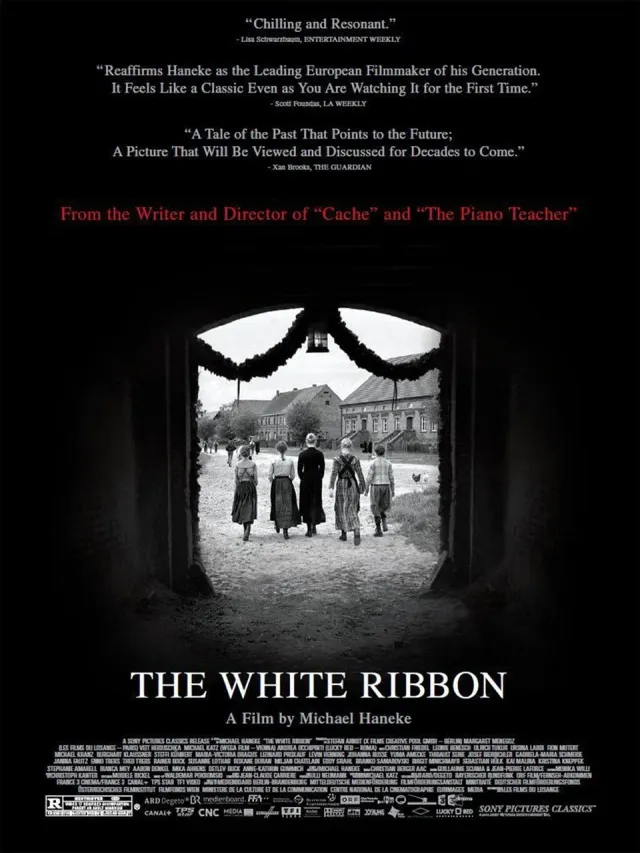
In a Protestant village in northern Germany shortly before World War I, a doctor is injured when his horse trips over a wire, and a series of other disturbing incidents unsettles the community. The schoolteacher narrates events as he remembers them, including the abuse and rigid discipline imposed by adults, the baron’s household and the children’s choral group. Suspicion moves through the village, but the events are never conclusively assigned to a single culprit. The film connects private cruelty with social authority while preserving the limits of what its older narrator can know. The adults’ punishments are visible, while the identities and motives behind the attacks remain uncertain.
What drives the story
A string of unexplained injuries and acts of damage exposes a village where adult authority depends on fear and punishment.
The people at its centre
Children live under different forms of coercion from their parents and employers; the teacher’s retrospective narration observes the damage but cannot provide a definitive culprit.
What it feels like
Black-and-white cinematography, measured pacing and restrained performances make the mystery feel like an inquiry into a social climate rather than a puzzle to solve.
Worth knowing
For viewers comfortable with austere, unresolved drama about authoritarian family and village life. Child abuse, corporal punishment and unexplained violence are central; its ambiguity is more social and historical than a conventional whodunit.
authoritychildhoodviolence
Mood
austere · unsettling · observational
Pacing
slow-burn · episodic inquiry
Visual style
black-and-white · formal compositions
Storytelling
unresolved incidents · family coercion · community suspicion