Creative blockage and bodily pain bring Salvador back to earlier relationships, while heroin opens memories rather than serving as a simple cure; memory and authorship remain unstable throughout.
Why this matches +
A bereaved woman's retreat unfolds alongside a filmmaker's story about the relationship between experience and invention.
Genres: Drama / Comedy
Shared film traits
Based on recorded story, mood and style. Your preferences can change the order.
What changes An aging male filmmaker's physical decline and childhood memories replace Elsa's bereavement and parallel story.
Aging film director Salvador Mallo lives with chronic pain and creative paralysis, then attends a screening of one of his old films and reconnects with actor Alberto. Their reunion brings back memories of childhood in Paterna, his mother’s sacrifices and a past relationship with Federico. When Salvador tries heroin, the drug opens a path into memories he has avoided; meanwhile, Alberto stages a monologue from one of Salvador’s texts. The film moves between present-day illness, remembered youth and fiction, eventually revealing that some apparent memories belong to a film Salvador is making.
The letter lets Julieta revisit the story without assuming her daughter will read it.
Why this matches +
A bereaved woman's retreat unfolds alongside a filmmaker's story about the relationship between experience and invention.
Genres: Drama
Shared film traits
Based on recorded story, mood and style. Your preferences can change the order.
What changes A mother-daughter estrangement replaces workplace avoidance and a filmmaker's parallel narrative.
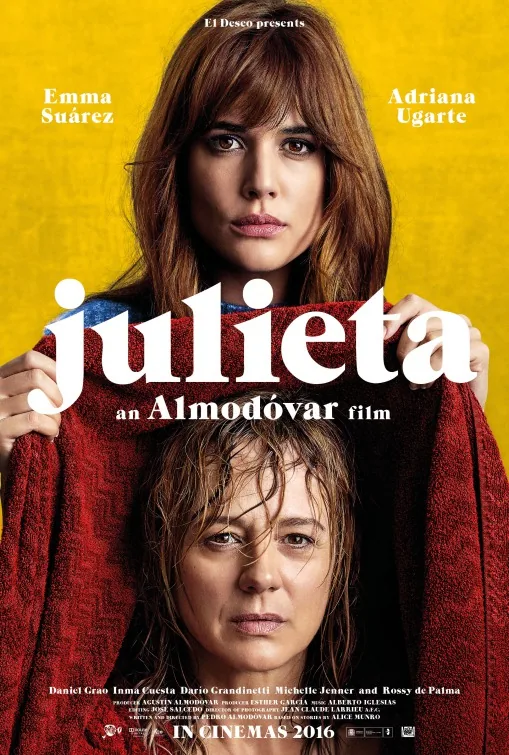
Julieta’s plans to leave Madrid change when she encounters a friend of her estranged daughter Antía. She returns to the apartment she once shared with Antía and begins writing a letter that recalls their relationship from childhood onward. The drama unfolds as a mother’s account of grief, guilt, and the limits of explanation, tracing how one family’s silences can persist long after a person has disappeared from daily life.
A son's death sends Manuela back to Barcelona, where her search for his other parent becomes a new set of caregiving commitments. The plot transforms a private bereavement into a wider, improvised family.
Why this matches +
A bereaved woman's retreat unfolds alongside a filmmaker's story about the relationship between experience and invention.
Genres: Drama
Shared film traits
Based on recorded story, mood and style. Your preferences can change the order.
What changes A son's death and theatrical community replace a mother's death and advertising work.
After her teenage son Esteban is killed while trying to get an actress's autograph, nurse Manuela returns to Barcelona to find his other parent and face a past she had left behind. She becomes involved with actresses, friends and people facing illness or abandonment, and care begins to move beyond the conventional family she thought she had lost. Almodóvar folds theatrical performance into intimate grief, linking maternal love to chosen kinship without presenting those connections as uncomplicated. The film's emotional center is not the search alone, but the network Manuela helps sustain.
A writer's inability to adapt a book becomes the film's plot; his effort to resist conventional story machinery eventually gives way to conspicuously conventional devices. The turn is both narrative event and self-critique.
Why this matches +
These selections share a specific story or viewing dimension; the recorded differences explain the limits of each comparison.
An adjacent discovery: a related idea with a different viewing experience.
Genres: Comedy / Drama
Shared film traits
Based on recorded story, mood and style. Your preferences can change the order.
What changes Metafictional comic escalation replaces a bereaved woman's holiday crisis.
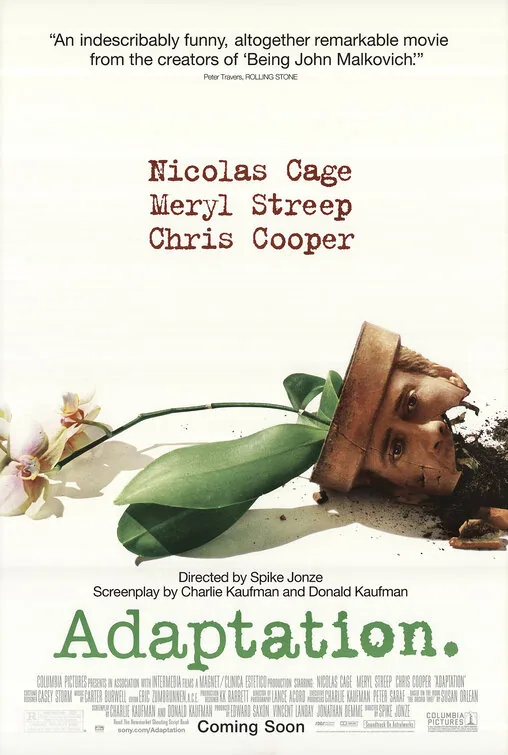
Screenwriter Charlie Kaufman struggles to adapt Susan Orlean's nonfiction book about orchid poacher John Laroche while feeling unable to write the kind of movie he thinks Hollywood expects. His confident twin brother Donald embraces conventional screenwriting lessons, and Charlie's fascination with Orlean makes research increasingly entangled with fantasy. The film eventually turns its own resistance to formula into a story that uses formula, crime and melodrama. By folding the writer, his brother and Orlean into a fiction that announces its inventions, it makes adaptation itself the subject and the joke.
After her mother's death, advertising executive Elsa keeps working through the December holidays rather than facing her loss. A crisis eventually takes her to Lanzarote with her friend Patricia. Another strand follows a filmmaker, bringing lived experience into contact with the stories people create from it. Grief, friendship and artistic invention intersect without turning the holiday setting into a promise of seasonal comfort.
What drives the story
A bereaved woman's retreat unfolds alongside a filmmaker's story about the relationship between experience and invention.
The people at its centre
Elsa's friendship with Patricia offers a counterpoint to work as a means of avoiding grief.
What it feels like
The premise supports an adult reflective drama about mourning and the unstable boundary between life and fiction.
Worth knowing
Christmas is the emotional setting rather than a guarantee of an uplifting holiday romance.