The legal case turns a private family loss into a public question about ownership and historical responsibility.
Why this matches +
These offer a related experience with a meaningful difference in story, tone, or presentation.
An adjacent discovery: a related idea with a different viewing experience.
Genres: Biography / Drama
Shared film traits
Based on recorded story, mood and style. Your preferences can change the order.
What changes A woman pursues truth and recognition across decades after political violence disrupts her family's history.
An older Austrian-American woman takes the Austrian government to court over a Gustav Klimt portrait stolen from her family during the Nazi era. With a young lawyer, she pursues restitution while revisiting the history of displacement and loss that shaped her life. The legal drama links a public property dispute to memory, cultural inheritance and the difficulty of asking institutions to recognize past injustice.
One man's career in presidential service spans changing approaches to civil rights.
Why this matches +
These offer a related experience with a meaningful difference in story, tone, or presentation.
An adjacent discovery: a related idea with a different viewing experience.
Genres: Drama / History
Shared film traits
Based on recorded story, mood and style. Your preferences can change the order.
Political resistance
What changes Family life and political struggle unfold together over decades, emphasizing the everyday cost of injustice and different responses to it.
Cecil Gaines recounts a life spent working in the White House, moving from a childhood shaped by racial violence in the South to decades serving successive presidents. His private life and the civil-rights movement unfold alongside one another, sometimes placing his gradual approach to change beside the more direct activism of his son. Lee Daniels frames the period drama around family, service and competing ideas of political progress.
Janis’s pregnancy and historical inquiry unfold beside her evolving connection with Ana, linking family identity to collective memory.
Why this matches +
These offer a related experience with a meaningful difference in story, tone, or presentation.
An adjacent discovery: a related idea with a different viewing experience.
Genres: Drama
Shared film traits
Based on recorded story, mood and style. Your preferences can change the order.
Political resistance
What changes Mothers confront concealed histories and the legacy of state violence as private family stories connect to public memory.
A Madrid photographer becomes pregnant after a relationship with a forensic anthropologist, and shares a maternity-ward room with Ana, a much younger expectant mother. Their lives remain connected after the birth as questions of parentage, care and personal history emerge. Janis’s effort to address a mass grave in her village links this intimate story to Spain’s unresolved Civil War memory.
A pre-vow family visit becomes a search for concealed wartime deaths, unsettling two women’s different ways of living with history and choosing a future. Wanda’s investigation and Ida’s vocation meet at family graves but lead to different future choices.
Why this matches +
These offer a related experience with a meaningful difference in story, tone, or presentation.
An adjacent discovery: a related idea with a different viewing experience.
Genres: Drama
Shared film traits
Based on recorded story, mood and style. Your preferences can change the order.
What changes A woman investigates a family history obscured by political violence and discovers how the past continues to shape personal identity.
Before taking religious vows, novice Anna visits her only surviving relative, Wanda, and learns that she was born Jewish and given a different name. Their journey to locate the remains of family members killed during the occupation leads to difficult questions about local violence, survival and what can be recovered from silence. Wanda’s political past and grief shape one response; Ida’s quiet discipline and uncertainty shape another. Their discoveries do not produce a simple replacement identity or a single verdict on Poland. The film’s black-and-white, nearly square compositions make its sparse spaces and withheld information part of the historical tension, not merely an elegant style.
Maria’s efforts to survive become increasingly entangled with the economic recovery around her, so success carries both agency and moral cost.
Why this matches +
These offer a related experience with a meaningful difference in story, tone, or presentation.
An adjacent discovery: a related idea with a different viewing experience.
Genres: Drama / Art
Shared film traits
Based on recorded story, mood and style. Your preferences can change the order.
What changes A woman adapts to uncertainty and political upheaval after war separates her family, tracing resilience through changing public circumstances.
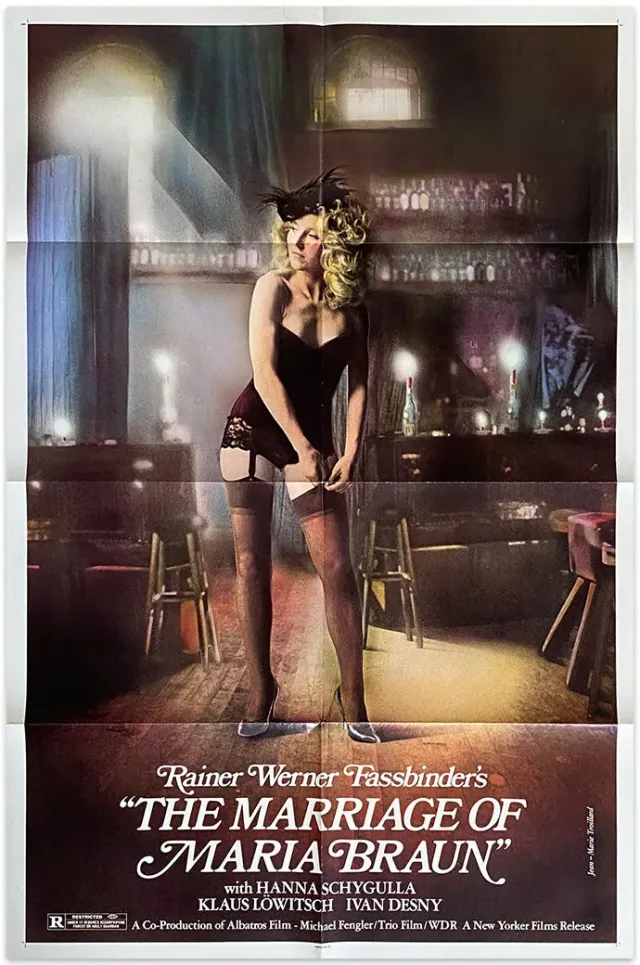
Maria Berger marries Hermann Braun during a wartime air raid, then loses him to the front and the uncertainty of Germany’s defeat. Believing him dead, she finds work in the unstable postwar economy and uses her intelligence and charm to secure a future for herself and her family. A relationship with American soldier Bill brings affection as well as practical support, while Maria continues to hold onto the idea of Hermann. As she rises from precarious survival into financial success, the film links her private compromises to a country rebuilding itself and postponing its reckoning with the past.
After former Brazilian congressman Rubens Paiva is taken by the military regime, his wife Eunice tries to learn what happened while caring for their children. The family home and the uncertainty surrounding his disappearance become part of a longer struggle over truth and memory. Walter Salles follows Eunice's perspective through a changing political landscape, making domestic endurance and later remembrance central to the historical drama.
What drives the story
A woman searches for truth after the dictatorship takes her husband away.
The people at its centre
Eunice's care for her children continues alongside her effort to establish what happened.
What it feels like
The story connects ordinary family life to public repression and later memory.
Worth knowing
Its measured approach gives weight to loss without turning the subject into a conventional thriller.
FamilyMemoryPolitical repression
Mood
Somber · Resilient · Reflective
Pacing
Character-led · Across decades
Visual style
Naturalistic period detail · Domestic spaces · Restrained camera
Storytelling
Forced disappearance · Family under regime · Historical memory