Based on recorded story, mood and style. Your preferences can change the order.
What changes Sing Sing is tagged empathetic and grounded; The Choral is tagged stirring and bittersweet.
In a northern English town during the First World War, a choral society tries to continue rehearsing as many of its men leave for military service. Its committee appoints a new choirmaster, whose methods challenge old habits and bring new voices into the group. Alan Bennett's drama links music-making with community resilience, showing how shared work can carry both grief and hope during a period of social change.
Based on recorded story, mood and style. Your preferences can change the order.
What changes Sing Sing: patient, performance-centered and observational. Whiplash: intense.
An ambitious jazz student earns a place in an elite ensemble led by a conductor who treats humiliation and psychological pressure as tools for producing greatness. The student's desire to prove exceptional talent makes approval increasingly difficult to separate from abuse. Rehearsal, competition and performance narrow his world as ordinary relationships and physical well-being become costs he is prepared to discount.
Based on recorded story, mood and style. Your preferences can change the order.
What changes Sing Sing: patient, performance-centered and observational. Drumline: training-to-performance.
A gifted drummer arrives at an Atlanta university and joins its celebrated marching band, where raw talent does not immediately translate into belonging. Rivalries, strict rehearsal and the demands of ensemble performance force him to reconsider what leadership means. The film places individual virtuosity inside a collective tradition, using musical competition to tell a coming-of-age story about discipline, respect and learning to play for more than oneself.
Based on recorded story, mood and style. Your preferences can change the order.
What changes Sing Sing: patient, performance-centered and observational. August Rush: building and musical.
A gifted young musician grows up in an institution and believes that music may help him find the parents he has never known. His path brings him to New York, where a street performer and a music teacher shape his development. The family drama links several musical lives through performance, coincidence and the hope that a shared language can overcome separation.
Based on recorded story, mood and style. Your preferences can change the order.
Work and ambition · Memory and identity
What changes Sing Sing: patient, performance-centered and observational. The Last Showgirl: measured, character-led and reflective.
Shelly has performed for decades in a Las Vegas revue that is about to close, leaving her to face a sudden end to the work that has organized her life. She tries to find another place in a changing entertainment city while reconnecting with her estranged daughter and relying on younger performers. The drama follows a woman negotiating aging, labor and self-worth when a familiar stage no longer guarantees a future.
Based on recorded story, mood and style. Your preferences can change the order.
Memory and identity
What changes Sing Sing: patient, performance-centered and observational. Here: a non-linear structure revisits one place across multiple generations.
The film remains anchored to one location while moving across different periods and generations of people who live in or pass through it. Domestic routines, relationships, and historical change become visible through the space itself, making the room a witness to lives it cannot control. The drama adapts a graphic-novel structure into a meditation on memory, time, family, and the meanings that accumulate around an ordinary place.
Based on recorded story, mood and style. Your preferences can change the order.
Work and ambition · Family and care
Expect restrained and somber, with measured and observational pacing.
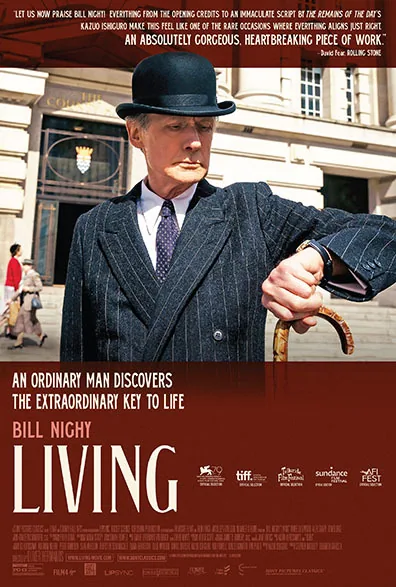
In 1950s London, senior council clerk Rodney Williams has spent years moving paperwork through a bureaucracy that leaves little room for initiative. A group of women’s petition for a playground returns to his desk, and a terminal diagnosis changes how he thinks about his remaining time. New employee Mr. Wakeling and other encounters help Williams redirect his attention toward a modest public project, in this English adaptation of Akira Kurosawa’s Ikiru.
Based on recorded story, mood and style. Your preferences can change the order.
Family and care
What changes Sing Sing: patient, performance-centered and observational. High Life: nonlinear, slow and contemplative and episodic crew history.
A group of prisoners serving life sentences is sent on a space mission toward a black hole, where a scientist conducts experiments on the crew. Monte, a reserved prisoner, tries to survive the journey and protect his young daughter Willow as the ship’s isolated routines and power imbalances deepen. The film uses its confined spacecraft, experimental medicine, and nonlinear storytelling to examine intimacy, coercion, parenthood, and the possibility of choosing a different life.
Based on recorded story, mood and style. Your preferences can change the order.
Memory and identity
What changes Sing Sing: patient, performance-centered and observational. Get on Up: nonlinear life episodes build toward legacy.
A musical biopic follows James Brown from a difficult childhood through the rise of a singular stage performer whose discipline and ambition reshape popular music. The narrative moves across time rather than offering a simple rise-and-fall sequence, connecting performance to family wounds, business power and the cost of control. Its energy comes from music and Brown’s forceful presence, alongside a frank look at the damage behind his success.
At Sing Sing Correctional Facility, Divine G finds purpose in a theater program where incarcerated men rehearse and perform plays. When a guarded newcomer joins, the ensemble considers its next production while negotiating trust, conflict and prison life. Rehearsal gives the men space to imagine beyond their circumstances, but does not erase those circumstances; their work connects artistic expression with friendship, rehabilitation and the difficult prospect of life after release.
What drives the story
An incarcerated theater group prepares a production while members seek purpose and connection.
The people at its centre
Divine G's creative confidence meets a newcomer's guardedness, and the ensemble builds trust through shared work.
What it feels like
Theatrical scenes and quiet conversations make personal change visible without simplifying prison life.
Worth knowing
The drama centers a specific arts program and its community rather than a conventional escape or courtroom story.