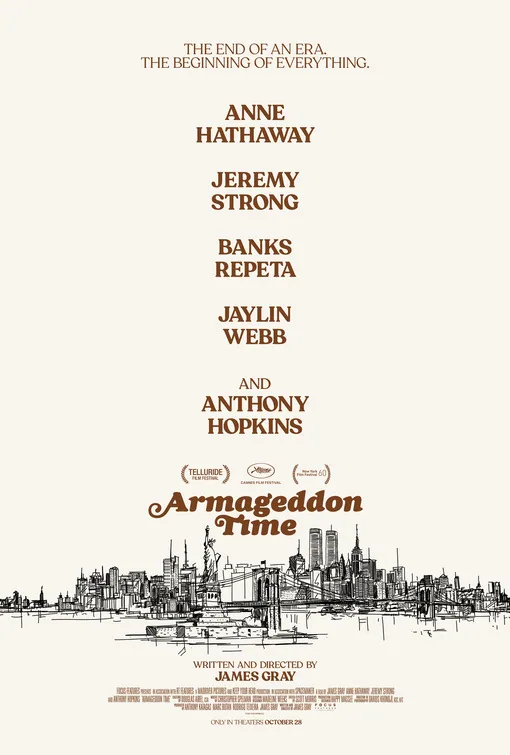
Both share themes of friendship, plus a reflective atmosphere.
Why this matches +
Genres: Drama
Shared film traits
Based on recorded story, mood and style. Your preferences can change the order.
Social hierarchy · Memory and identity
Expect nostalgic and uneasy, with episodic and reflective pacing.
Paul Graff begins sixth grade in 1980 Queens, where his friendship with classmate Johnny grows alongside trouble at school. Paul’s family hopes to secure his future, while his grandfather encourages his artistic ambitions and offers a different account of the family’s past. When Paul is sent to a private school, the differences in opportunity and treatment between the boys become harder to ignore, turning an autobiographical coming-of-age story into a portrait of family, class and race.
Both share themes of memory, plus a somber and compassionate atmosphere.
Why this matches +
Genres: Drama
Shared film traits
Based on recorded story, mood and style. Your preferences can change the order.
Memory and identity
What changes Nickel Boys: measured, episodic and reflective. Mass: the couples establish the terms of a meeting, exchange memories of their sons and and approach painful questions about warning signs and responsibility..
Six years after a school shooting, two couples meet in a private room at an Episcopal church. One pair lost their son; the other are the parents of the teenage perpetrator. Their conversation revisits childhood memories, the events leading to the tragedy and what each family can bear to hear, without offering an easy resolution to their grief or questions.
Based on recorded story, mood and style. Your preferences can change the order.
What changes Nickel Boys: measured, episodic and reflective. Moonlight: measured.
Across childhood, adolescence and adulthood, a quiet boy from Miami learns different ways to protect himself from bullying, instability at home and expectations of masculinity. A drug dealer and his partner offer care complicated by the economy harming his mother, while one friendship creates a vulnerable possibility of intimacy. The divisions between the three periods reveal how a hardened adult identity can preserve earlier wounds without extinguishing the desire to be known.
Based on recorded story, mood and style. Your preferences can change the order.
Political resistance · Memory and identity
What changes Nickel Boys: measured, episodic and reflective. Fences: dialogue-led scenes accumulate into rupture and reckoning.
A sanitation worker in 1950s Pittsburgh tries to hold authority within his household while carrying anger from opportunities and racial barriers he believes were denied to him. His marriage and relationships with his sons reveal the consequences of treating protection as control. The adaptation of August Wilson’s play keeps its attention on language, family intimacy and the burden of history rather than broad external action.
Based on recorded story, mood and style. Your preferences can change the order.
Expect somber and tense, with measured and domestic escalation pacing.
In the 1950s, teenager Tobias and his mother Rosemary move to a small Washington town after she leaves her previous life behind. Rosemary hopes to build a stable home with Dwight, but his charm in public gives way to controlling behavior and abuse in private. Tobias responds with rebellion, evasions and dreams of a different future, while the boys around him model other ways to survive the household. The story is based on Tobias Wolff’s memoir, though the film is a dramatization rather than a documentary record. Its central conflict is the struggle to retain a sense of self in a coercive home. Tobias tests the adults’ promises, seeking a school and future that Dwight’s control seems designed to deny him.
Both share themes of memory, plus a compassionate and reflective atmosphere.
Why this matches +
Genres: Drama / History
Shared film traits
Based on recorded story, mood and style. Your preferences can change the order.
Memory and identity
Expect moving and reflective, with interwoven timelines and steadily building pacing.
In 1938, London stockbroker Nicholas Winton visits Prague and encounters refugee families facing the threat of Nazi persecution. He helps organize a rescue effort to bring children to safety in Britain, while the film also follows Winton decades later as he reflects on those he could not save. The dual-time structure connects a practical act of coordination with the burden of memory, asking how one person understands responsibility after history has moved on.
Based on recorded story, mood and style. Your preferences can change the order.
What changes Nickel Boys: measured, episodic and reflective. Wonder: school-year arc and ensemble.
After years of homeschooling and medical treatment, fifth-grader August Pullman begins attending a mainstream school. His facial difference affects how classmates respond to him, but the film also follows his sister Via, friends and school community, showing how his arrival changes their relationships. Auggie faces bullying and loneliness while finding allies and moments of humor; the story does not treat kindness as an instant solution to social pressure. Stephen Chbosky adapts R. J. Palacio’s novel through several characters’ points of view. Via's and the friends' viewpoints broaden the question from who welcomes Auggie to how the community behaves. School incidents affect siblings and classmates, not only the new student.
Based on recorded story, mood and style. Your preferences can change the order.
Survival
What changes Nickel Boys: measured, episodic and reflective. Steve: school's fragile routine is introduced, student and staff crises accumulate and future of the institution becomes urgent.
Steve is the headteacher of a last-chance reform school for boys with serious social and behavioral difficulties. Over one pivotal day, he tries to protect the school's integrity and stave off its impending closure while supporting students whose lives have been shaped by exclusion and instability. Shy, a troubled teenager, struggles with anger and his own uncertain future as staff respond to mounting crises. Set in mid-1990s England and adapted from Max Porter's novella Shy, the drama examines the fragile work of care inside an institution running short on time and resources.
Based on recorded story, mood and style. Your preferences can change the order.
What changes Nickel Boys: measured, episodic and reflective. Nymphomaniac: episodic and measured.
After stranger Seligman finds Joe injured in an alley, he takes her to his apartment, where she recounts her sexual history across eight chapters and two volumes. Joe describes her adolescence, relationships, compulsions and later efforts to live with the consequences of her behavior, while Seligman repeatedly reframes her memories through his interests in music, fishing, mathematics and literature. Their conversation becomes an argument about whether her story can be separated from shame, diagnosis or the listener’s own needs. After Joe falls asleep, Seligman enters her room and attempts to assault her; she shoots him as he approaches, abruptly breaking the trust his listening seemed to build. The film’s structure moves between explicit memory and abstract analogy rather than presenting a neutral case history.
In 1960s Florida, Elwood Curtis is sent to a brutal reform school after a wrongful arrest, where he befriends the more pragmatic Turner. The boys negotiate the institution's violence and uncertain rules for staying safe, while their different understandings of resistance shape their bond. RaMell Ross's adaptation of Colson Whitehead's novel uses subjective visual perspectives, making memory and the boys' relationship central to a history of abuse and survival.
What drives the story
Two boys endure an abusive reform school while forming distinct ideas about survival and resistance.
The people at its centre
Elwood's belief in justice and Turner's guarded pragmatism shape a friendship under constant pressure.
What it feels like
Subjective camera choices place viewers near lived experience and make memory part of the film's form.
Worth knowing
Its formal perspective is integral to an account of institutional violence, not a conventional historical overview.