Both share themes of memory, plus a raw and reflective atmosphere.
Why this matches +
Genres: Drama
Shared film traits
Based on recorded story, mood and style. Your preferences can change the order.
Memory and identity · Mental health
What changes The Chronology of Water: episodic, associative and emotionally cumulative. The Outrun: nonlinear, reflective and gradually grounding.
After years of drinking in London, Rona returns to the remote Orkney islands where she grew up and begins rebuilding her life. The film moves between her present attempt at sobriety, memories of a difficult childhood and the relationships that led her to leave. Working among wind, sea and wildlife gives Rona a practical daily rhythm, but recovery remains uneven, shaped by family care, shame and her search for a way to inhabit the place again.
Based on recorded story, mood and style. Your preferences can change the order.
Sport and competition
Expect determined and tense, with training-focused and survival-driven pacing.
At sixty, long-distance swimmer Diana Nyad returns to an ambition she has pursued for decades: a nonstop journey from Cuba to Florida. She asks close friend and former partner Bonnie Stoll to train and support her, assembling a crew whose skills become essential during repeated attempts through currents, fatigue and marine hazards. The sports drama focuses on persistence and friendship while adapting a contested real-world achievement through a character-centered account.
Based on recorded story, mood and style. Your preferences can change the order.
What changes The Chronology of Water: episodic, associative and emotionally cumulative. Fish Tank: patient observation and gradual emotional disturbance.
Fifteen-year-old Mia lives with her mother and younger sister in an Essex housing estate, feeling restless and isolated from the people around her. Dance is one of the few things that gives her a sense of direction. When her mother’s new boyfriend enters the household, Mia becomes drawn into a complicated relationship that changes her understanding of trust and adulthood. Andrea Arnold’s British drama follows her through a compressed period of family tension and self-discovery, using close observation and a young protagonist’s perspective to depict a life with few easy choices.
Both share themes of memory and trauma, plus an intimate and raw atmosphere.
Why this matches +
Genres: Biography / Drama
Shared film traits
Based on recorded story, mood and style. Your preferences can change the order.
Memory and identity · Mental health
What changes The Chronology of Water: episodic, associative and emotionally cumulative. Honey Boy: memory-driven, alternating timelines and character-centered.
Actor Otis Lort enters rehabilitation after a destructive incident, where therapy encourages him to revisit his childhood. In flashbacks, young Otis works on film sets while living with his father James, a former rodeo clown whose support and volatility are difficult to separate. The story moves between adult treatment and the boy’s memories, exploring how performance, work, and a complicated parent-child bond shape Otis’s understanding of himself.
Based on recorded story, mood and style. Your preferences can change the order.
Memory and identity · Mental health
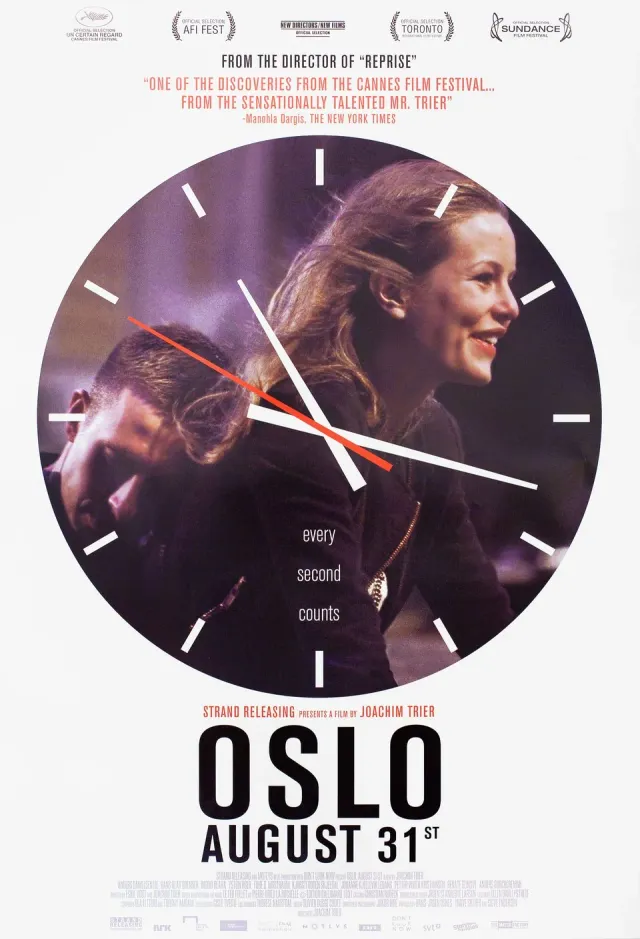
What changes The Chronology of Water: episodic, associative and emotionally cumulative. Oslo, August 31st: measured, conversational and quietly escalating.
Recovering addict Anders receives a day’s leave from treatment to attend a job interview in Oslo. He visits a friend, encounters people from his former life and moves through the city as he considers whether sobriety offers a future he can inhabit. Conversations about work, family, love and aging bring the gap between his hopes and what he has left undone into focus. Joachim Trier’s drama follows a single day with close attention to loneliness and the fragile possibility of beginning again.
Both share themes of memory, plus an intimate and reflective atmosphere.
Why this matches +
Genres: Drama
Shared film traits
Based on recorded story, mood and style. Your preferences can change the order.
Memory and identity · Mental health
What changes The Chronology of Water: episodic, associative and emotionally cumulative. The Room Next Door: deliberate, conversation-led and quietly intense.
Ingrid, a successful writer, reconnects with Martha, a former colleague now living with terminal cancer. Martha asks Ingrid to stay close as she prepares to end her life on her own terms, and the two women retreat to a country house where companionship and difficult conversations replace the routines of the hospital. Their friendship, memories and conflicting responses to death create an intimate drama about autonomy, care and the limits of what one person can decide for another.
Based on recorded story, mood and style. Your preferences can change the order.
Memory and identity
What changes The Chronology of Water: episodic, associative and emotionally cumulative. The Lost Daughter: slow-burn, interior and memory-driven.
On a Greek island holiday, professor and translator Leda Caruso observes a young mother, Nina, struggling with the demands of caring for her daughter. A missing doll becomes an unsettling focus for Leda, while memories of her own years as a mother return through flashbacks. As Leda and Nina speak, the film explores choices, resentment, desire, and the parts of motherhood people rarely admit aloud. Maggie Gyllenhaal’s adaptation of Elena Ferrante’s novel is a psychological character study with a deliberately uneasy view of intimacy and maternal identity.
Based on recorded story, mood and style. Your preferences can change the order.
What changes The Chronology of Water: episodic, associative and emotionally cumulative. Girl, Interrupted: measured and episodic.
After a suicide attempt, Susanna is admitted to a psychiatric hospital where her relationships with patients, staff and the charismatic Lisa challenge the diagnoses and accounts she has brought with her. Lisa’s rebellion gives Susanna a model of resistance but also exposes how manipulation can travel inside a language of freedom. The film’s adaptation of Susanna Kaysen’s memoir turns institutional life into an ensemble story about care, illness and identity, yet its focus on one young woman’s crisis cannot stand for all psychiatric treatment or diagnoses. Recovery is neither simply obedience nor glamorous rejection of help.
Based on recorded story, mood and style. Your preferences can change the order.
Sport and competition
What changes The Chronology of Water: episodic, associative and emotionally cumulative. The Smashing Machine: fight preparation and relationship scenes trace a cycle of achievement and strain.
The biographical drama follows mixed martial artist Mark Kerr through his rise in the late 1990s, his demanding training, and the complicated relationship with girlfriend Dawn. Athletic success is accompanied by chronic pain and dependence on painkillers, making the body that wins fights also the source of a private crisis. The film focuses on ambition, intimacy, and the cost of treating endurance as proof of strength.
Adapted from Lidia Yuknavitch’s memoir, the film follows Lidia from a difficult childhood into adulthood, where competitive swimming, intimate relationships, addiction, and writing become entwined with her effort to understand her past. Kristen Stewart shapes the story through a nonlinear, sensory approach that treats memory as something revisited and rewritten. Water becomes both a physical discipline and a recurring image for survival and self-expression.
What drives the story
Lidia's life is organized through memories that connect physical survival with the search for a voice.
The people at its centre
Swimming and writing offer forms of control as family trauma and adult relationships complicate her path.
What it feels like
The film uses a fluid, associative form to bring remembered experience into the present tense.
Worth knowing
Its portrait of recovery remains specific to the memoir's voice instead of turning hardship into a simple triumph arc.